


Start Your Project Today
Tell us about your project — we’ll get back within 24 hours

Founder
User Interface Design
The software development life cycle covers every phase a piece of software passes through, from an initial idea to a live, maintained product. It typically runs through six stages: planning, design, development, testing, deployment, and maintenance.
Each phase produces a concrete deliverable before the next one starts. Planning produces a scoped requirement document, design produces a technical blueprint, development produces working code, and testing produces a verified, defect-checked build ready for release. The MVP vs. POC vs. Prototype distinction is usually what teams work through just ahead of a formal SDLC kickoff, before committing to full development.
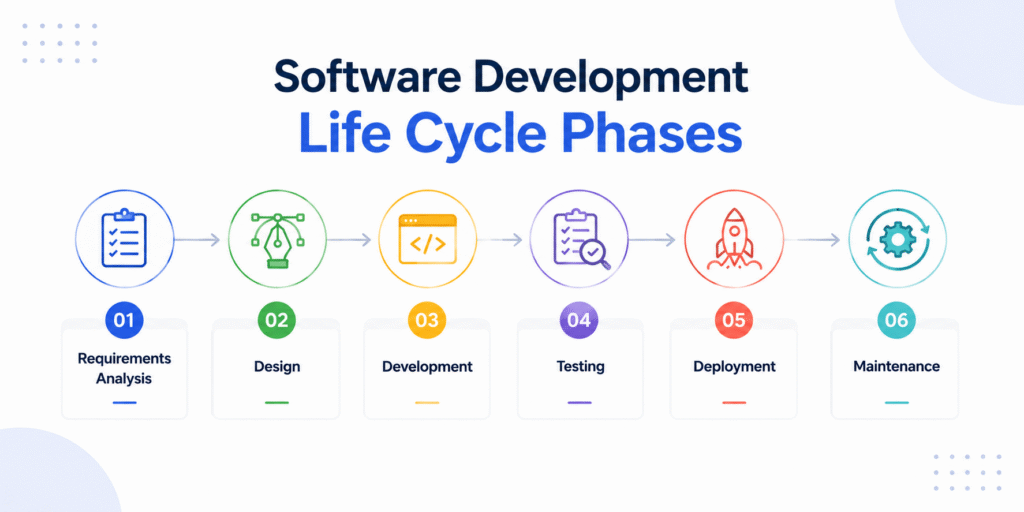
Development is where the blueprint becomes working code, followed by testing, which verifies that code against the original requirements rather than just checking that it runs. Deployment moves the verified build into production, and maintenance keeps it running, patched, and current until the next planning cycle begins.
None of these phases work well in isolation. A design document that skips edge cases forces developers to make undocumented assumptions, and testing that starts only after development finishes tends to surface problems too late to fix cheaply. The real value of the SDLC comes from treating each handoff between phases as deliberately as the phases themselves.
Every SDLC model arranges these same phases differently, depending on how much a project’s requirements are expected to change once work begins. Waterfall completes each phase fully before starting the next, agile breaks work into short, repeatable cycles, and a hybrid approach borrows structure from both.
The tradeoff underneath every model is the same: how much certainty you want upfront versus how much room you want to change direction later. Waterfall trades flexibility for a fixed, quotable scope. Agile trades upfront certainty for the ability to redirect based on what’s actually learned once real users see the product.
| Model | Best project type | Risk tolerance fit | Typical cost/timeline impact |
|---|---|---|---|
| Waterfall | Well-defined scope, stable requirements | Low: little room for mid-project change | Predictable upfront, expensive to alter after design is locked |
| Agile | Evolving requirements, iterative feedback | High: built to absorb changing priorities | Harder to fix-price upfront, cheaper to redirect mid-project |
| Hybrid | Fixed core with some flexible modules | Moderate: structure where it matters, flexibility elsewhere | Balances predictability against adaptability |
The right model is less about which one is objectively better and more about how much your requirements are genuinely expected to shift. A fixed-scope compliance project suits waterfall’s predictability, while a consumer product still being validated with users benefits from the faster feedback loops agile app development is built around.
When a business hires a software development partner rather than building in-house, the partner’s SDLC discipline matters as much as their technical skill. A strong partner can clearly walk you through exactly how requirements move from planning into a signed-off design document, keeping scope aligned at every stage.
Ask how the partner handles requirement sign-off, documents design decisions before development starts, and schedules testing alongside development rather than only at the end. Getting this right is a core part of what makes mobile app development outsourcing work well, since distributed teams benefit from having that handoff tracked deliberately from day one. A custom software development company in Bangalore working across distributed teams should be able to show clearly how handoffs between design and development are tracked, which keeps scope consistent throughout an outsourced project.
A development partner’s process discipline matters even more once personal data enters the picture, since data protection in India isn’t a separate checklist; it runs through the same phases you’d already be evaluating. The Digital Personal Data Protection Rules, 2025 require a Data Fiduciary to embed consent notices, purpose limitation, and reasonable security safeguards into how a system is designed, not bolted on after launch.
This means design decisions about what data fields to collect, testing decisions about how breach scenarios get simulated, and deployment decisions about where data is stored all carry compliance weight within an IT governance platform. Failing to maintain reasonable security safeguards alone can attract a penalty of up to ₹250 crore, which makes data protection a design-phase conversation rather than a pre-launch afterthought.
Most SDLC failures in outsourced or distributed projects trace back to gaps between phases rather than weak execution within any single phase. Requirements drift is the most common: a business describes what it wants in a kickoff call, but without a signed-off requirement document, both sides quietly shift scope as development progresses.
Handoffs between design and development are a second common gap, especially when the same team does not own both phases. A design document that looks complete on paper can still be missing the edge cases a developer needs answered, which then get resolved informally instead of through a documented change.
Security testing shows the same pattern. Government guidance on secure application development, including guidelines CERT-In issued for secure design, development, and operations, expects security to be built into every phase rather than treated as a final gate before release. Building security testing in alongside design, rather than saving it for right before deployment, keeps fixes cheaper and catches issues while they’re still easy to address.
Getting the SDLC right comes down to treating phase handoffs as seriously as the phases themselves: a signed-off requirement document before design starts, a reviewed design before development starts, and security and compliance built into that sequence rather than checked at the end. Zethic runs client projects this way, with requirement sign-off and design review treated as gated checkpoints rather than formalities to move past quickly. For businesses evaluating a development partner, Zethic walks through exactly how requirements, design, and testing hand off to each other before any code gets written.
Let Zethic help you build smarter Not just faster
Ram brings deep expertise in product strategy and system architecture across fintech, SaaS, and AI platforms. He specializes in pre-execution planning to help teams build scalable technology foundations and avoid costly rebuilds.

Adding {{itemName}} to cart
Added {{itemName}} to cart