


Start Your Project Today
Tell us about your project — we’ll get back within 24 hours


A founder hears that fine-tuning can make an AI model sound exactly like their brand, then gets three wildly different quotes ranging from a few thousand rupees to several lakh for what sounds like the same project. The cost to fine-tune an LLM depends on three things that rarely get explained clearly: which technique you use, how big the model is, and how much your data actually needs cleaning up before training even starts. Here is what actually drives the number, and when the spend is worth it at all.
Fine-tuning means taking a pre-trained foundation model and training it further on your own dataset, so its outputs match your specific domain, tone, or task. This is different from training a model from scratch, which involves building the underlying architecture and can cost tens of millions of dollars, a scale no ordinary business ever needs to consider.
Most fine-tuning projects today use low-rank adaptation methods that update only a small subset of the model’s weights rather than the entire network. This single choice is what separates a fine-tuning project that costs a few hundred rupees from one that costs several lakh, the same tiered thinking that shows up in AI agent development cost in India once a project moves past a single-task build.
The cost to fine-tune an LLM swings from under a thousand rupees to well over a crore because three variables move independently of each other, and most quotes only mention one of them.
Fine-tuning is not always the right first step, and many businesses spend lakhs on the cost to fine-tune an LLM when a well-built retrieval system would have fixed the same problem for a fraction of the price. Retrieval-augmented generation pulls answers from your existing documents at query time instead of baking that knowledge into the model itself, which is really the RAG-versus-fine-tuning decision that shapes cost more than anything else in a generative AI project.
Once fine-tuning is genuinely the right call, the cost to fine-tune an LLM breaks into clear tiers based on model size and business scenario, the same kind of scoping a software development company would walk through before quoting a project. These figures reflect low-rank adaptation, the default starting point for most budgets, and exclude the hidden costs covered in the next section.
| Scenario | Low-Rank Adaptation (LoRA/QLoRA) |
| Pilot project (small model, under 8B parameters) | ₹800 to ₹25,000 |
| Mid-size model (8B to 13B parameters) | ₹25,000 to ₹2,50,000 |
| Enterprise-scale model (40B+ parameters) | ₹2,50,000 to ₹12,00,000 |
| Ongoing hosting (self-managed GPU, monthly) | ₹80,000 to ₹2,70,000 |
Full fine-tuning, retraining the entire model rather than a small subset of its weights, costs several multiples more at every tier above and is rarely the right starting point unless low-rank methods have already been ruled out for a specific technical reason.
The compute bill is often described as only half the real cost to fine-tune an LLM, and the rest shows up in places most first-time budgets miss entirely. Data preparation alone can quietly account for a significant share of total project cost, well before a single training run begins.
Fine-tuning earns back its upfront cost fastest in high-volume, narrow-task settings, where a shorter fine-tuned prompt or faster response measurably cuts your ongoing running cost per query. A retailer that fine-tunes a model to generate consistent product descriptions at scale, for instance, can recover the training cost within a few months once labor savings and query volume are factored in, a pattern that shows up across AI chatbot development use cases wherever volume is high enough.
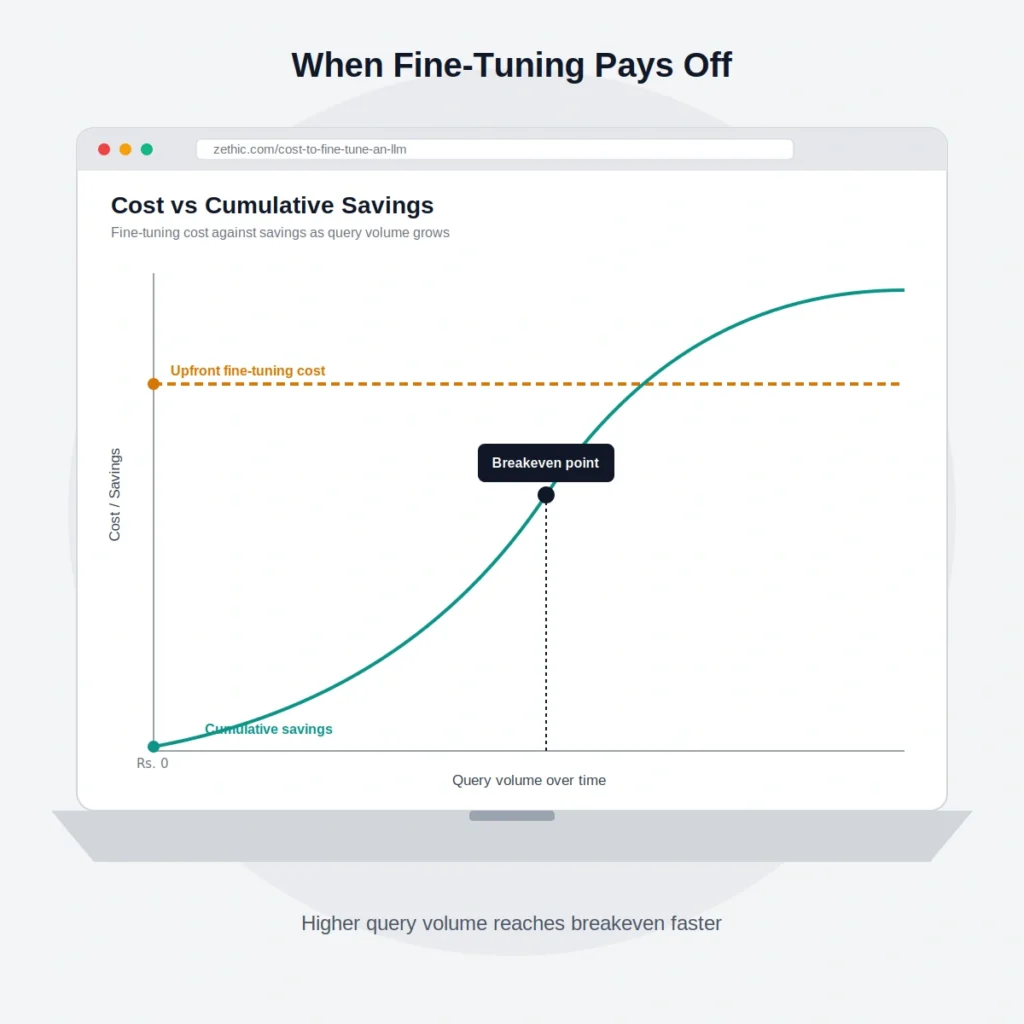
The breakeven point depends entirely on query volume and how much the fine-tuned model reduces token usage or manual labor per request. Below a certain volume, the ongoing cost to fine-tune an LLM and keep it current can exceed simply paying for a general-purpose model as needed.
Most businesses do not need a fine-tuned model on day one. They need an honest answer to whether fine-tuning solves their actual problem, and a clear cost picture before committing engineering budget to find out.
Zethic works with founders and CTOs across fintech, logistics, and software services to assess whether the cost to fine-tune an LLM is actually justified for a specific use case, and where a retrieval-based approach or a hybrid setup would get the same result for less.
Ram brings deep expertise in product strategy and system architecture across fintech, SaaS, and AI platforms. He specializes in pre-execution planning to help teams build scalable technology foundations and avoid costly rebuilds.
