


Start Your Project Today
Tell us about your project — we’ll get back within 24 hours

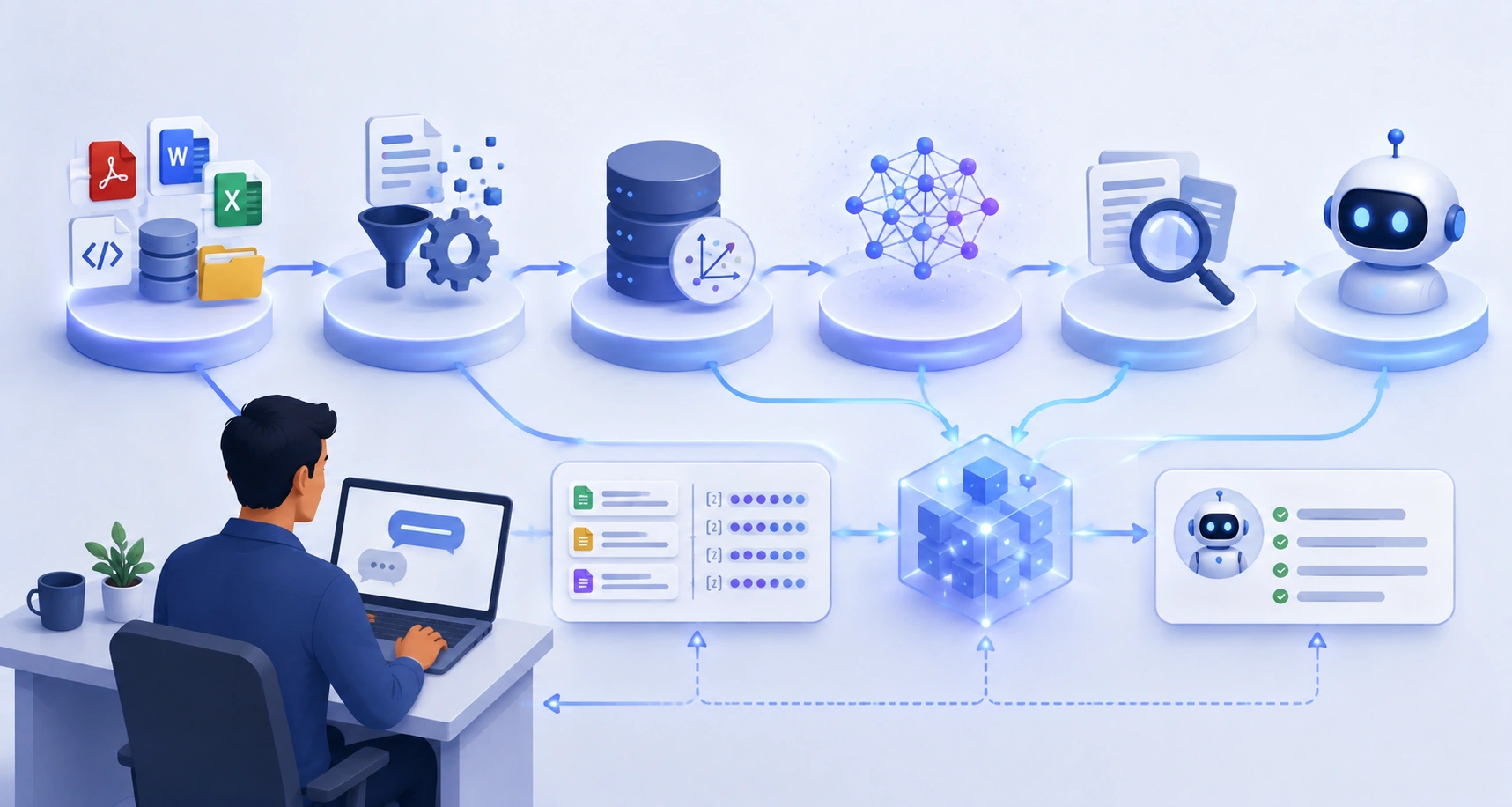
A team spends weeks building a RAG application, only to find it confidently gives wrong answers once real users start asking real questions. This usually has nothing to do with the AI model and everything to do with skipped planning steps earlier in the process. Here are the actual stages involved in building a RAG application, and what a business needs to decide at each one.
Every RAG application moves through the same set of stages, whether it is built for customer support, internal search, or something more specific to one industry. Agentic AI in fintech builds on this same staged foundation once a workflow needs to act, not just answer. Understanding these stages matters because a demo that works in a week can still take months to become something real users can rely on.
Most delays and budget overruns in a RAG project trace back to decisions that were never made clearly at the start. Compliance and data quality get treated as afterthoughts far too often, a mistake that quietly drives up AI chatbot development cost in India as well. Answering these questions before you build a RAG application saves far more time than it costs.
| Decision Point | What to Define | Risk if Skipped |
| Use case | Which specific questions the system must answer well | Team builds something too broad to test properly |
| Data sources | Which documents count as trusted, and who owns them | System retrieves outdated or conflicting information |
| Security rules | Who can see which documents, and how access is controlled | Sensitive data becomes visible to the wrong users |
| Accuracy bar | How wrong an answer is allowed to be before it is a real problem | No way to tell if the system is actually working |
| Update frequency | How often the underlying documents actually change | Index goes stale without anyone noticing |
This part of the process runs once up front, then again each time your documents change, rather than every time a user asks a question. Much of what determines how smoothly it goes has less to do with RAG specifically and more to do with AI integration for existing systems, since messy legacy data causes the same headaches regardless of what you’re connecting it to. It is the part most businesses underestimate when they first try to build a RAG application on a real timeline.
Once the data is prepared, a second and completely separate process runs every time someone asks a question. This is the part users actually experience, and it needs to happen quickly, usually in a second or two. Speed matters here for the same reason it matters in AI chatbot development: a slow answer feels broken even when it’s accurate.
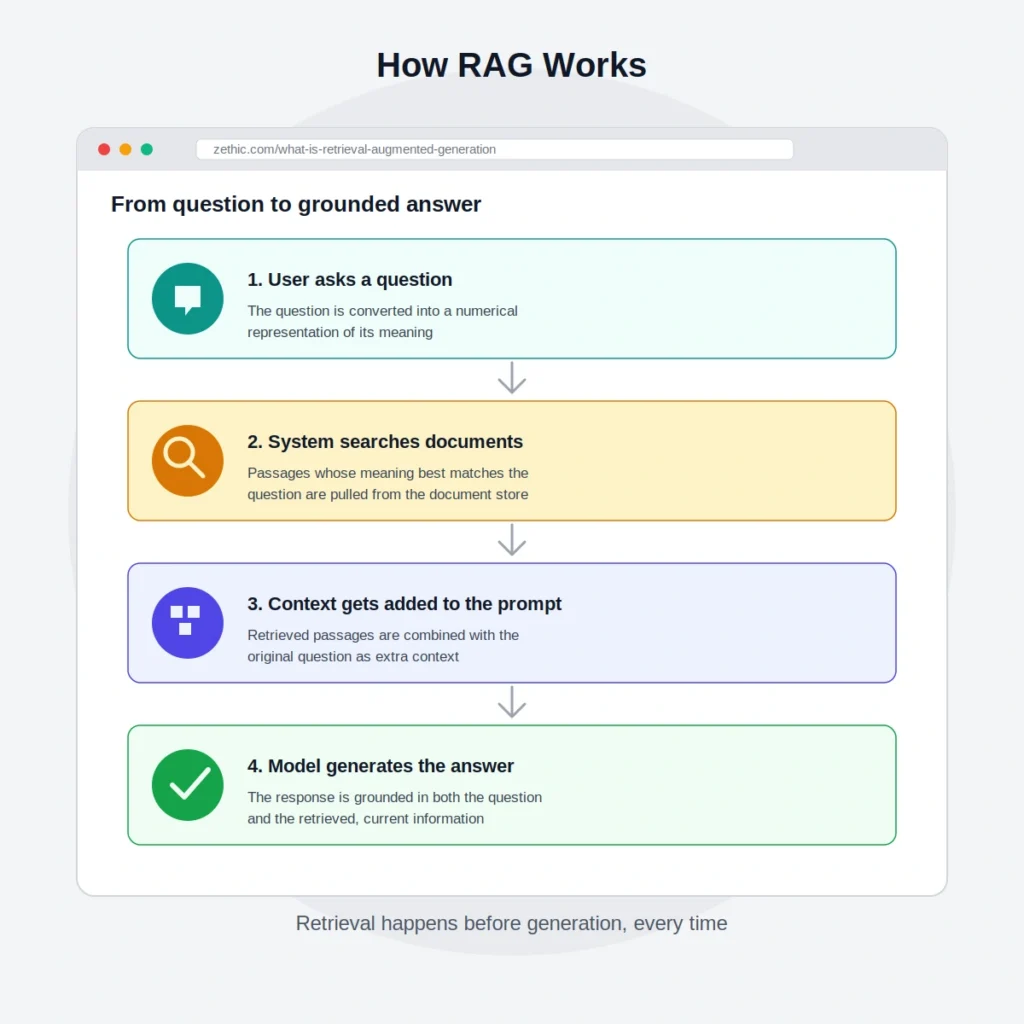
The question gets turned into the same searchable form as the stored documents, the system finds the closest matches, and those matches get handed to the model along with the original question. The model then writes an answer using only that information, rather than guessing from memory.
A RAG application is not a one-time build. Documents change, policies update, and a system that was accurate on launch day can quietly become wrong within weeks if nobody is watching it, the kind of drift a software development company plans maintenance for on any long-lived system.
Most failed RAG projects are not failures of the underlying model. They are failures of the data and planning work that should have happened before anyone tried to build a RAG application around the model in the first place.
Most businesses do not need a general RAG framework. They need a system scoped around their actual documents, their actual users, and how often that information genuinely changes, since that is what it really takes to build a RAG application worth using.
Zethic works with founders and CTOs across fintech, logistics, and software services to plan each stage of a RAG build around real data and real security requirements, rather than a generic starting template.
Ram brings deep expertise in product strategy and system architecture across fintech, SaaS, and AI platforms. He specializes in pre-execution planning to help teams build scalable technology foundations and avoid costly rebuilds.
