
Skip links

How to Monetize a Fintech App: 7 Business Models That Work

Picture of By Ram Nethaji

By Ram Nethaji

Founder

FinTech app development cost

User Interface Design

Custom software development
FinTech app development services
Monetize in fintech
The global fintech market reached $394.88 billion in 2025 and is projected to hit $1.76 trillion by 2034 at a CAGR of 18.2%, per the Fortune Business Insights fintech market report. Yet 69% of publicly listed fintech firms only turned profitable in 2024, up from less than half the year before. The gap between building a fintech product and building a profitable one comes down to one decision: how you monetize in fintech from the start, not as an afterthought.

Why Does Monetization in Fintech Require a Different Approach?

Fintech products operate inside regulatory frameworks that constrain pricing, lending rates, data usage, and fee structures. A consumer app can charge whatever the market bears. A fintech product cannot; it needs a monetization model that fits within what regulators permit, what users trust, and what the product’s unit economics can sustain at scale.

Three constraints that make monetising fintech decisions different from standard app monetization:

  • Regulatory boundaries: RBI lending rate guidelines, zero MDR on bank-to-bank UPI transactions, and DPDP Act data consent requirements all directly shape which revenue models are viable in India.
  • Trust dependency: Financial products live or die on user trust. Monetization that feels extractive creates churn faster than in any other app category, which is why a fintech design agency that understands both revenue model and user trust is essential when designing the flows where monetization surfaces.
  • Unit economics pressure: KYC, compliance, fraud detection, and infrastructure costs are structurally higher in fintech. Many of them are the hidden costs in fintech app development that most initial product budgets do not account for until the first compliance audit.

What Are the 7 Business Models to Monetize a Fintech App?

Choosing how to monetize in fintech is a product architecture decision, not a pricing decision. The model you choose at launch shapes your cost structure, compliance obligations, and growth ceiling.
Monetize in fintech
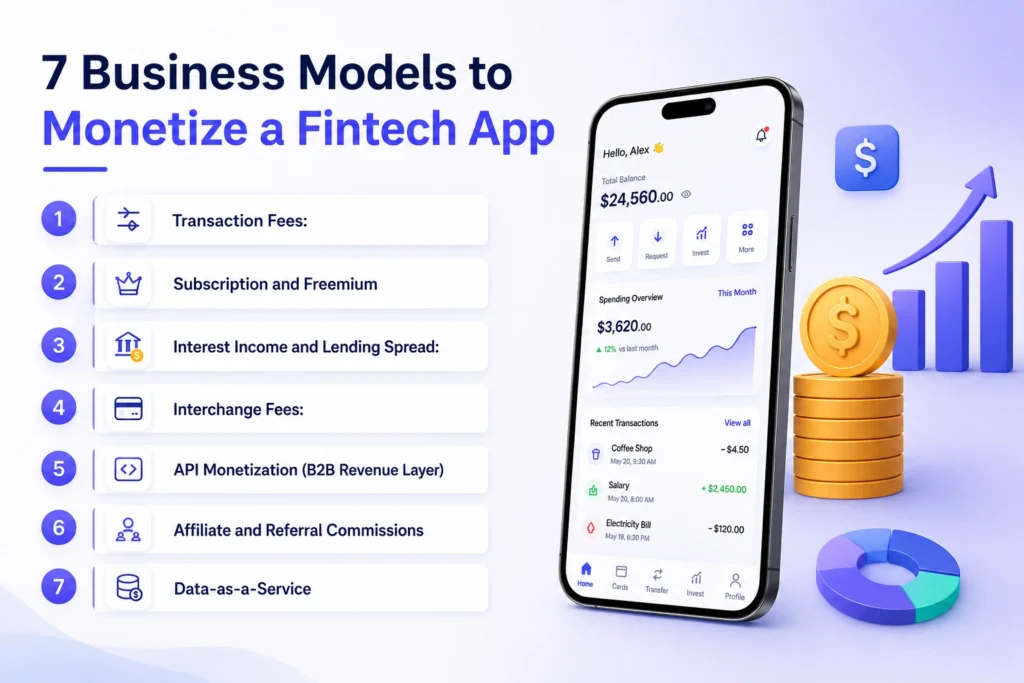
  1. Transaction Fees: The most widely used model. Platforms earn a percentage or flat fee on every successful transaction. Payment apps, wallets, and remittance platforms use this model. In India, debit card MDR is capped at 0.90% by the RBI, bank-to-bank UPI transactions carry zero MDR, and PPI wallet transactions above Rs 2,000 attract a 1.1% interchange fee under NPCI’s 2023 circular. At scale, even small per-transaction rates compound significantly; a platform doing Rs 100 crore in monthly transaction volume at 0.5% earns Rs 50 lakh per month from this model alone. The revenue model only holds if the underlying payment gateway software is built to handle high transaction volumes with low failure rates and reliable settlement.
  2. Subscription and Freemium: Users pay a recurring fee (monthly or annual) to access premium features: advanced analytics, higher transaction limits, priority support, or investment tools. The freemium variant gives a functional free tier and converts a portion of users to paid. Typical B2C fintech subscription ARPU in India ranges from Rs 99 to Rs 499 per month for consumer apps. B2B fintech SaaS typically runs Rs 999 to Rs 9,999 per month, depending on feature depth.
  3. Interest Income and Lending Spread: Lending platforms, BNPL products, and neobanks with credit features earn the spread between the cost of capital and the interest rate charged to borrowers. This is one of the highest-margin models when done well. In India, NBFCs are permitted to set their own lending rates (there is no statutory cap for most categories), but the RBI Digital Lending Guidelines require transparency in rate disclosure and fee structures, including mandatory APR disclosure upfront in a Key Fact Statement before any loan contract is executed.
  4. Interchange Fees: When a fintech issues a debit or prepaid card through a BaaS partner bank, it earns a share of the interchange fee every time a cardholder makes a transaction. Credit card MDR in India ranges from 0.7% to 2.2% depending on the merchant category (PwC). The issuing fintech typically earns 0.3% to 0.8% of the transaction value as its interchange share. Neobank app development that includes card issuing infrastructure from day one is what makes interchange a meaningful revenue line at scale, alongside subscription fees.
  5. API Monetization (B2B Revenue Layer): Fintech platforms that build proprietary financial infrastructure (credit scoring engines, KYC pipelines, payment rails, data connectors) can license access to other businesses via API. This is the model Plaid uses globally and how Account Aggregator-licensed entities are beginning to operate in India. API monetization is high-margin and scales with third-party adoption rather than end-user growth. Pricing models include per-API-call billing, monthly flat-fee access, or tiered volume pricing.
  6. Affiliate and Referral Commissions: Fintech platforms earn commissions by connecting users to third-party financial products: insurance policies, mutual funds, loans, credit cards, or savings accounts. The product does not hold a licence to sell these products; it earns a distribution fee for the referral. This model works particularly well for personal finance apps, credit score platforms, and aggregators. Commission rates in India range from 0.5% to 2% of the product value for lending referrals and Rs 200 to Rs 1,500 per policy for insurance referrals.
  7. Data-as-a-Service: Aggregated, anonymised financial behaviour data is valuable to retailers, lenders, insurers, and research firms. Fintech platforms that handle large transaction volumes can monetize data insights (spending patterns, credit behaviour, category trends) to institutional buyers. In India, the Digital Personal Data Protection Act 2023 requires explicit user consent for each data use purpose. Any fintech building data-as-a-service revenue must invest in a consent management layer at the product level, the same layer that governs KYC in fintech onboarding and sits at the intersection of identity verification and data rights.

Which Monetization Model Fits Your Fintech Product?

The right model depends on what your product does, who pays, and what the regulatory environment permits. Most founders try to map a model to their product too late, after the architecture is set and changing the revenue model requires rebuilding parts of the product.

Product Type Primary Model Secondary Model
Payment app / wallet Transaction fees Subscription (premium tier)
Neobank Interchange fees Subscription + lending spread
Lending / BNPL platform Interest income / lending spread Affiliate commissions
Personal finance / budgeting app Subscription / freemium Affiliate commissions
B2B fintech SaaS Subscription API monetization
Investment / wealthtech platform AUM fee (% of assets managed) Subscription
Credit score / aggregator app Affiliate commissions Data-as-a-service

When Should You Combine Multiple Revenue Streams?

The most sustainable fintech products stack revenue models rather than relying on one. The sequencing matters; launching with too many models creates compliance overhead and product complexity before you have product-market fit.

A practical three-stage approach:

  • Launch stage: One primary model only. Keep compliance scope narrow, prove unit economics, and avoid overwhelming users with monetisation signals before they understand the product’s value.
  • Growth stage (6 to 18 months): Add one complementary model. A transaction-fee platform adds a subscription tier for power users. A lending platform adds affiliate commissions for products it does not lend itself.
  • Scale stage (18 months+): Layer in B2B or data models. Once consumer-side volume is proven, API monetization and data insights become viable without cannibalising the core product.

What Should You Watch Out for When You Monetize in Fintech?

India-specific regulatory constraints directly shape which monetization decisions are viable. Ignoring these at the architecture stage creates expensive compliance debt later.

Four considerations specific to monetizing fintech products in India:

  • UPI zero MDR: Bank-to-bank UPI transactions carry zero MDR, confirmed by the Finance Ministry in 2025. Payment apps building transaction-fee models on UPI P2M volume need to account for this in their revenue projections. PPI wallet transactions above Rs 2,000 attract a 1.1% interchange, but this applies only to PPI merchants, not standard bank-to-bank transfers.
  • RBI digital lending norms: The RBI’s 2022 Digital Lending Guidelines require all lending apps to disclose the Annual Percentage Rate (APR) upfront, prohibit automatic credit limit increases without explicit consent, and mandate that loan disbursals and repayments flow directly between the borrower and the regulated entity. These directly constrain how BNPL and lending spread models can be structured.
  • DPDP Act data consent: Data monetization requires fresh, specific consent for each data use purpose. Pre-ticked consent boxes, bundled consent, and retroactive data use are all non-compliant. Any fintech building data-as-a-service revenue must invest in a consent management layer at the product level, not as an add-on.
  • FLDG cap for lending partnerships: The RBI’s 2022 guidelines capped First Loss Default Guarantees (FLDG) at 5% of the loan portfolio for fintech-bank co-lending arrangements. This affects how lending fintechs structure risk-sharing agreements with partner banks and directly impacts the unit economics of the lending spread model.

What Should You Do Next?

Monetization in fintech is not a decision that can be bolted on after the product is built. The revenue model determines the compliance framework, the data architecture, the partner bank relationships, and the product features that need to exist from day one. A lending spread model requires an NBFC licence or a co-lending partnership. An interchange model requires a BaaS relationship and card issuing infrastructure. A data model requires consent management built into onboarding.

The decisions that shape how you monetize in fintech are architecture decisions first, and they are also what separates fintech app developmentprojects that ship profitably from those that stall at the compliance or unit economics stage. Zethic builds fintech software developmentproducts where those decisions are made at the architecture stage, helping founders map the right monetization model to the right product structure from the start. If you are at that stage, Zethicis a good place to start.

Let Zethic help you build smarter Not just faster

Frequently Asked Questions

Transaction fees are the most widely used model. Platforms earn a percentage or flat fee on every successful transaction. Payment apps, wallets, and remittance platforms typically start here because the revenue scales directly with usage.

Bank-to-bank UPI transactions carry zero MDR, confirmed by the Finance Ministry in 2025. PPI wallet transactions above Rs 2,000 attract a 1.1% interchange fee under NPCI’s rules, but this is paid by the merchant and does not apply to standard bank transfers.

After proving the core product value at the free tier. Most successful fintech products launch with one free or subsidised model, prove retention, then layer in paid tiers at the growth stage.

Yes, with strict conditions. The Digital Personal Data Protection Act (2023) requires explicit, purpose-specific user consent for each data use. Raw transaction data cannot be sold. Anonymised, aggregated insights can be monetized, provided the consent architecture is built correctly into the product from onboarding.

Yes, and most mature fintech products do. The key is sequencing: launching with one primary model, proving unit economics, then adding complementary revenue streams at the growth and scale stages rather than building multiple models into the product from day one.

Let’s build your app together

Table of Contents

zethic-whatsapp