


Start Your Project Today
Tell us about your project — we’ll get back within 24 hours


As a development team takes on more projects, deployment practices tend to diverge from one project to the next. This increases operational risk and slows onboarding. Coolify deployment is now the standard process across close to 200 of our services, and every project follows the same steps from code to release.
Coolify is an open-source platform for deploying and managing applications on servers that an organisation owns or rents. It operates as a management layer on top of Docker, so each application runs as a container, and every project follows a common process.
Two terms are worth distinguishing. Hosting keeps an application available on a server, and deploying releases a new version of it. Coolify supports both: it deploys each release and then manages the running application.
Its core capabilities include:
We previously used Ploi for server management, and it met our needs while the portfolio was smaller. As the number of projects increased, consistency across them became the priority. Four requirements shaped the decision:
For example, Node.js and PHP projects followed different deployment routes. This is manageable for a small portfolio, but it adds coordination effort as the portfolio expands. We also favour open-source tools, in keeping with our own mock API server, which we published as open source.
The most significant change is that all deployments are now Docker-based. Docker packages an application together with its dependencies, so a project behaves consistently across development and production environments. This is now the standard for every project.
| Area | Earlier setup | With Coolify |
| Deployment process | Steps varied by project | One standard Docker process |
| Process knowledge | Held by the person who worked on the project | Shared through the same guidelines for every project |
| Server access | Developers often logged in directly | Developers deploy without server access |
| Starting a deployment | Manual steps on the server | Automatic when code is pushed to a branch |
| Change history | No clear record of server changes | Changes arrive through the repository and Coolify |
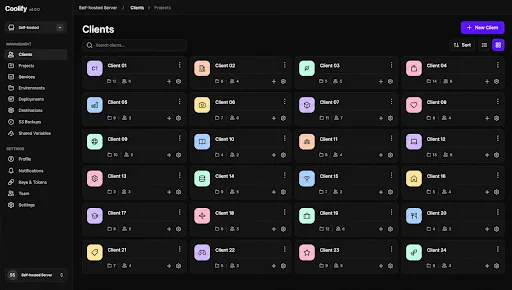
Each project follows the same sequence:
Because the configuration is stored in the repository, a new team member can read it and understand how the project is deployed. Developers concentrate on code, while Coolify handles the build and release steps.
We currently manage around 8 servers, which run roughly 180 to 200 services through Coolify. These include production websites and applications for our clients on servers we manage, together with development applications that are tested before release.
At this scale, a standard process supports predictability. When every service is deployed in the same way, routine releases require less coordination. The same applies to organisations that divide an application into microservices, where many small services benefit from a common routine.
Coolify provides control over deployments without slowing delivery:
Limiting direct server access reduces the risk of unintended changes and protects production environments.
The following practices support a smooth transition:
For a first server, Coolify’s documentation lists a minimum of 2 CPU cores, 2 GB of RAM and 10 GB of free storage, with Docker and SSH access to the server. Docker images, volumes and backups need additional storage, so organisations running several applications usually need more.
As a software development company, we see the benefit of a standard process across several roles:
| Role | What they gain |
| Developers | Push to a branch and monitor the deployment, with no server login needed |
| Engineering leads | One standard process across every project, which simplifies reviews and handovers |
| Clients | A consistent, documented way in which their applications are deployed and managed |
We adopted Coolify to address a requirement within our own engineering team. The same principle guides our client engagements: identify the process that depends on individual knowledge and convert it into a standard that any team member can follow. Coolify is open source, so organisations can begin on their own servers and adapt the platform to their needs.
Our engineering services support this kind of work:
At Zethic, we use Coolify to turn deployment into a repeatable routine that any member of the team can follow. Teams that manage several servers can follow the same approach. Our engineering team can review a current setup and suggest a practical path to a standard process. We recommend starting with one development server and a single project, so the team can confirm the process before production services move. The remaining projects can then follow the same routine in stages.

Head of Delivery Varun leads delivery and engineering teams across a wide portfolio of client engagements, turning complex requirements into predictable, well-run projects. He specializes in delivery operations and AI-driven workflows that help teams ship reliably while keeping quality and client trust at the center of every build.
