


Start Your Project Today
Tell us about your project — we’ll get back within 24 hours

Founder
User Interface Design
FinTech app development services
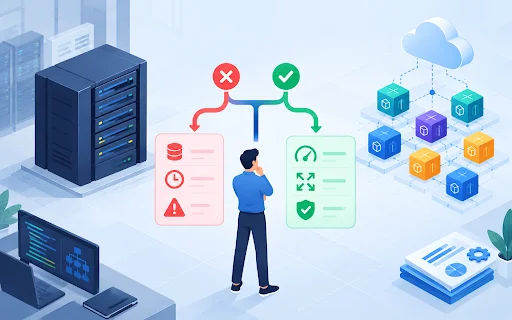
A team spends eight months rewriting a working product into forty separate services because a conference talk made monoliths sound outdated. Eighteen months later, deployments take longer than before, and half the team spends its time explaining the new system to the other half. A monolith to microservices migration only earns its cost when a business chooses it because of a genuine bottleneck, not an industry trend.
A monolith is a single deployable application where the UI, business logic, and data access all live in one codebase and ship together. Microservices split that application into separate, independently deployable services, each owning one business function and communicating over a network. Federal guidelines for microservices-based application systems define this same architecture: small, loosely coupled services that communicate over lightweight protocols.
Neither approach is inherently better. A monolith is simpler to build, test, and run when a product is small or still finding its shape. Microservices add real value once independent deployment, team autonomy, or isolated scaling become worth their added operational weight.
Migration earns its cost when specific, measurable friction already exists, not when it might exist someday. The signals below are the ones worth tracking before committing engineering time to a rewrite.
When two or more of these signals show up together, the case for migration gets much stronger than any single symptom on its own. The same signal-based thinking applies to replacing a legacy system altogether, not just splitting it into services.
Remaining a monolith is the right call more often than most engineering discussions admit, especially early on. Many of the products that eventually justify microservices spent their first few years as monoliths, growing into the need for them rather than architecting for it up front.
According to Gartner’s research on modernizing applications for the cloud, these efforts commonly fall short of expectations when goals are vague, requirements are incomplete, and effort is underestimated going in. This matches what CNCF’s 2025 survey found: the leading obstacle organizations report today is cultural resistance inside the development team, not technical complexity, cited by 47 percent of respondents. A monolith with no active bottleneck means the problem the migration would solve does not exist yet.
None of these signals are permanent. Team size grows, CI/CD pipelines mature, and the product’s shape settles, at which point the reasoning above can change.
A modular monolith keeps everything in a single deployable unit but enforces strict internal boundaries between modules, the way separate services would, without the network calls between them. Teams can work on separate modules with real isolation, and the codebase stays ready for a future split into actual services if a bottleneck eventually appears. Getting the boundaries right takes the same discipline Intelligent Engineering applies to any project: module ownership, clear interfaces, and enforced dependencies.
Applications already built on distributed computing patterns and service-oriented boundaries take far less effort to convert to microservices later than those bolted together with no internal structure at all. A modular monolith is effectively that preparation step, done deliberately instead of by accident.
Legacy system integration is usually the hardest part of a monolith to microservices migration, harder than writing the services themselves. The system that has been running the business for years cannot simply go offline while new services are built around it.
The Strangler Fig pattern lets a team build new functionality as separate services while the existing monolith keeps running underneath it, gradually routing traffic to the new services one function at a time rather than cutting over all at once. An Anti-Corruption Layer sits between the old and new systems, translating data and calls so the legacy system’s assumptions do not leak into the new services. An API gateway then gives external callers one stable entry point while the migration continues behind it.
This combination lets a business keep the legacy system operational and revenue-generating throughout the migration, rather than freezing feature work for months while everything is rebuilt at once. It is the same phased approach behind most legacy software modernization work, regardless of which architecture the system ends up moving to.
Cost depends heavily on scope: migrating one bounded piece of a system costs far less than a full enterprise rearchitecture, and most programs land somewhere between those two extremes. A useful anchor point is treating a single pilot extraction as the base unit, then scaling the estimate by how many additional services the legacy system needs broken out.
| Migration Scope | Cost (USD) | Cost (India, ₹) |
| Single-service extraction (pilot) | 40,000-150,000 | ₹35 lakh-₹1.3 crore |
| Partial migration (several bounded services) | 150,000-800,000 | ₹1.3 crore-₹6.5 crore |
| Full enterprise rearchitecture | 800,000-3,000,000+ | ₹6.5 crore-₹25 crore+ |
The India-side figures run lower mainly because of the difference in engineering labor cost between the two markets, not because the work is smaller in scope. Timeline follows a similar pattern: a pilot often takes eight to twelve weeks, while a full rearchitecture typically runs twelve to twenty-four months depending on how many services need to be broken out. Where the work blurs into a broader rewrite of business logic rather than a clean architectural split, it starts to look more like software re-engineering than a migration, and the estimate should reflect that.
The right starting point for any monolith to microservices decision is naming the actual bottleneck, not picking an architecture because it is popular. If deployment collisions, one component’s scaling needs, or a genuine compliance boundary are already causing real pain, migration is worth its cost. If none of those are true yet, a modular monolith usually captures most of the same benefit for a fraction of the operational overhead.
Zethic works with engineering teams to name that bottleneck honestly before recommending a path, then builds the migration around the Strangler Fig and Anti-Corruption Layer patterns so the legacy system keeps running while new services come online underneath it.
Let Zethic help you build smarter Not just faster
No. Microservices only pay off when specific problems, like deployment collisions or one component’s scaling needs, already exist. Without those problems, a monolith or modular monolith is usually the better choice.
A single-service pilot typically takes eight to twelve weeks. A full enterprise rearchitecture commonly runs twelve to twenty-four months, depending on how many services the system needs to be split into.
A modular monolith is a single deployable application with strict internal boundaries between its modules, giving teams much of the isolation microservices offer without the operational cost of running many separate services.
Yes. Patterns like the Strangler Fig approach and an Anti-Corruption Layer let new services take over one function at a time while the legacy system keeps handling everything else.
There is no fixed number, but teams under roughly ten to fifteen backend engineers rarely see enough coordination benefit to justify the added operational cost of running separate services.
Migrating before a real bottleneck exists is the most common and costly mistake, since it adds real operational complexity against a problem that has not actually appeared yet.
Ram brings deep expertise in product strategy and system architecture across fintech, SaaS, and AI platforms. He specializes in pre-execution planning to help teams build scalable technology foundations and avoid costly rebuilds.

Adding {{itemName}} to cart
Added {{itemName}} to cart