A team patches the same aging system for three years, quietly avoiding the harder conversation about rebuilding it, then discovers the “cheap” patch-and-extend approach has cost more than a full modernization would have. This gets treated as an all-or-nothing decision when it almost never is. The real work is matching the right strategy to a specific system, not picking between “leave it alone” and “rewrite everything.”
What Is Legacy Application Modernization?
Legacy application modernization is the process of updating an aging system, whether that means its code, its infrastructure, or its entire architecture, so it can keep supporting the business without the mounting cost and risk of leaving it as-is. It is not the same thing as a cloud migration.
A cloud migration, often called a lift-and-shift, moves an application to new infrastructure without touching its code or architecture. Modernizing legacy applications can include that step, but the deeper versions of the work change how the system is built, not just where it runs. That distinction matters, since a business that only moves servers often finds the same underlying problems waiting for them on the new infrastructure — the gap Legacy Application Modernization Services is built to close.
Why Does Legacy Application Modernization Cost Vary So Wildly?
Search for a modernization budget and the numbers span an enormous range, from tens of thousands of dollars to several million. That spread isn’t inconsistent pricing. It reflects different amounts of work hiding under the same label.
| Strategy Tier |
What It Involves |
Cost (USD) |
Cost (India, ₹) |
| Rehost/replatform |
Move to new infrastructure or update the runtime, minimal code change |
$30,000-$150,000 |
₹2 lakh-₹20 lakh |
| Refactor/re-architect |
Restructure code and system design while preserving business logic |
$150,000-$800,000 |
₹15 lakh-₹50 lakh |
| Rebuild/replace |
Full rewrite or a new system built from scratch |
$450,000-$2,300,000+ |
₹10 lakh-₹1 crore+ |
A quote near the low end and a quote near the high end aren’t necessarily competing bids for the same job. They’re often answers to two different questions, and the first step in legacy software modernization is figuring out which question applies to a specific system.
SaaS development cost in India and globally swings just as widely, for the same reason: headline figures depend on scope, not inconsistent quoting.
Which Modernization Strategy Fits Your System?
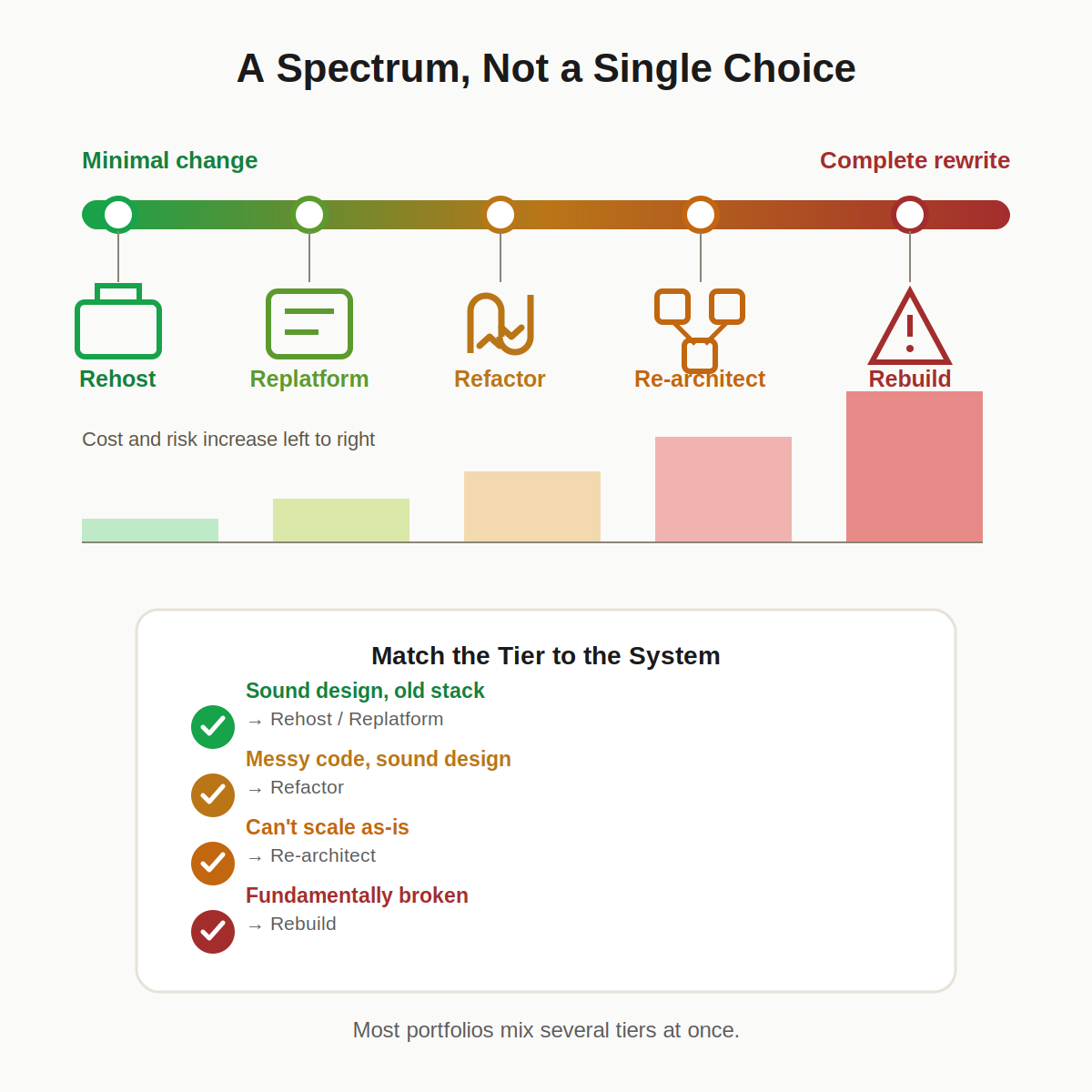
The strategies behind these cost tiers are often called the 7 Rs, and most modernization efforts mix several of them across a portfolio of systems rather than applying just one everywhere.
- Rehost: Move the application to new infrastructure unchanged, the fastest and lowest-risk option for a system whose architecture is still sound
- Replatform: Update the runtime, database, or framework without rewriting core logic, useful when the code works but the stack is unsupported
- Refactor: Restructure the code itself to reduce technical debt without changing what it does, the core of most legacy code modernization work
- Re-architect: Redesign the system’s structure, often breaking a monolith into services, for a system that needs to scale beyond its current design
- Rebuild or replace: Rewrite from scratch or swap in a commercial product, reserved for systems too costly or risky to evolve incrementally
Matching the tier to the system, not the other way around, is what keeps a modernization project inside its budget. A team that defaults to the same strategy for every system, whether that’s always rehosting or always rebuilding, ends up either underinvesting in systems that need real structural work or overspending on ones that didn’t need it. The
custom software vs off-the-shelf decision runs on the same math: the cheaper option upfront isn’t always cheaper once total cost of ownership is counted.
When Should You Modernize vs. Keep Patching?
Patching makes sense right up until it doesn’t, and the signal is rarely a single dramatic failure. It’s usually a pattern: the same fix taking longer each time, a vendor dropping support, or a security review flagging the same unresolved gap two audits in a row. Unpatched, unsupported software shows up constantly in
CISA’s Known Exploited Vulnerabilities catalog, the government’s own running list of flaws attackers are actively exploiting right now.
Industry research consistently puts legacy system maintenance at 60-80% of total IT budget for organizations that keep deferring modernization, which leaves little left over for anything else. Once maintenance is consuming that share of the budget, patching has already become the more expensive option, even though it doesn’t feel that way month to month.
The math rarely gets run this way in practice, since patching costs are spread across many small line items while a modernization budget shows up as one large number. That framing makes the smaller, recurring cost look safer than the larger, one-time investment, even when the recurring cost adds up to more over a few years.
What’s the Difference Between Legacy Code Modernization and Full Application Modernization?
Legacy code modernization is a narrower, code-level version of this work: restructuring or rewriting the code itself, often through refactoring, without necessarily touching the surrounding infrastructure or architecture. It fits a system where the design is sound, but the code has become hard to maintain, test, or extend safely.
Full application modernization is broader and can include infrastructure, architecture, and integration changes alongside the code. A business can do meaningful legacy code modernization without a full application modernization effort, particularly when the goal is reducing risk in a specific module rather than transforming the entire system.
Choosing the narrower option first is often the more disciplined move. A team that isolates the riskiest or hardest-to-maintain piece of code, modernizes that in isolation, and only expands scope once that work proves out tends to spend less overall than one that commits to a full system overhaul from day one. Knowing
how to choose a software development company often comes down to this same scoping judgment, since a partner who can tell the two apart has likely done this work before.
What Happens If a Modernization Project Fails?
Modernization has a real failure problem, and multiple current industry analyses put the share of projects that miss their goals or significantly exceed budget at somewhere around 70%. The pattern behind most of these failures is consistent: a team chose a bigger, riskier strategy, like a full rebuild, when a narrower refactor or replatform would have solved the actual problem.
Scope creep compounds the risk further. A rebuild that starts as a faithful replacement for the old system often grows into an attempt to fix every complaint about it at once, which extends the timeline and multiplies the number of things that can go wrong before launch.
The businesses that avoid this outcome tend to share one habit: they scope the smallest change that solves the actual problem, then treat anything beyond that as a separate decision to be justified on its own, rather than bundling it into the same project by default. Matching the right team to the job matters just as much in the
in-house vs outsourced AI development decision as picking the right strategy does here.
How Should Your Business Approach Legacy Application Modernization?
There’s no universal answer to how to modernize a legacy application, because the right strategy depends entirely on what condition a specific system is in. The businesses that get this right start by diagnosing the system honestly before picking a strategy, not the other way around.
Zethic works with founders and CTOs to run that diagnosis first, scoping whether a system needs a simple rehost, a targeted refactor, or a full rebuild, and sizing the real cost and timeline before committing to either. Zethic builds the resulting modernization plan around the system’s actual condition rather than the most dramatic option available.