


Start Your Project Today
Tell us about your project — we’ll get back within 24 hours

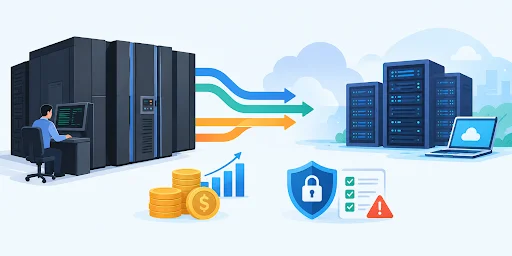
A bank’s core transaction system still runs on COBOL written before most of its engineering team was born, and the two people who can touch it safely are both retiring this year. Mainframe modernization gets treated as one all-or-nothing rewrite when it rarely is. The real decision is which of several distinct paths fits a specific application, not whether to modernize at all.
Mainframe modernization is the process of updating applications, architecture, integrations, or infrastructure within a mainframe environment so the system keeps supporting the business without compounding cost and risk. Migration is a narrower term within that process: it specifically means moving an application, workload, or dataset from one environment to another.
Mainframe modernization can include migration, but it doesn’t have to. Exposing COBOL business logic through modern APIs, for instance, is one of the most effective ways to modernize legacy applications without moving them off the mainframe.
Businesses often assume the two are interchangeable because most conversations start with a migration pitch. In practice, an application with sound architecture rarely needs to move; it needs new interfaces built around it, a modernization decision, not a migration one.
The right path depends on how much an application is worth to the business weighed against its technical health, the same starting point for any legacy system, with mainframe-specific options layered on top.
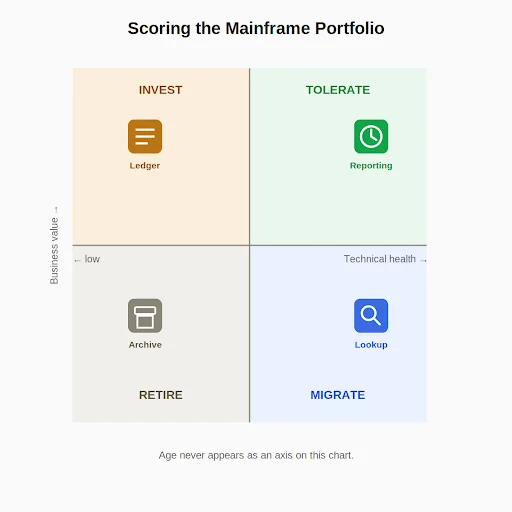
Most enterprise programs combine more than one of these across their application portfolio rather than picking a single path for everything, which is why staffing usually calls for Software Engineering built to run more than one track at once.
The costliest mistake is treating rehosting as a finish line. Moving COBOL from an on-premises mainframe to a cloud-hosted emulator doesn’t reduce dependence on COBOL specialists or make data accessible to modern applications. It relocates the same technical debt onto newer infrastructure, a legitimate first step only if the business understands that’s all it is.
COBOL modernization is more than translating a programming language. Enterprise COBOL applications carry decades of embedded business rules, batch processing sequences, transaction flows, and tightly coupled hardware dependencies that a language conversion alone doesn’t resolve.
A structured COBOL modernization effort typically includes application discovery, mapping every program, dependency, and batch process before touching code, followed by equivalence testing that confirms the modernized system produces identical output across every code path. In banking and insurance, that testing routinely consumes 25-40% of a program’s effort, since even a slightly different rounding or date-handling result isn’t considered ready to go live. That same standard of proof, not just a passing test but byte-for-byte equivalence, applies to GDPR compliance for fintech apps as well, where regulated data handling gets held to the same exacting bar.
Cost varies more by chosen path than any other factor, and treating a single number as “the” mainframe modernization cost is where most budget estimates go wrong.
| Modernization Approach | Cost (USD) | Cost (India, ₹) |
| Assessment and roadmap only | 200,000-400,000 | ₹1.5 crore-₹3 crore |
| Rehost (emulator-based) | 600,000-5,000,000+ | ₹5 crore-₹40 crore+ |
| Automated refactoring or full rearchitecture | 2,000,000-15,000,000+ | ₹16 crore-₹1.2 billion+ |
COBOL talent scarcity has become its own line item. Qualified COBOL developers now command 175,000-220,000 a year, 40-60% above equivalent Java pay, and that gap shows up in every quote that still needs someone who can read the existing code. For a bank running this system, that modernization cost has to be weighed against what banking compliance software costs to retrofit if a regulatory review flags the same system first.
Waiting rarely improves this math. Mainframe processing costs tied to MIPS pricing have risen roughly 15-20% in new enterprise agreements recently, meaning the cost of standing still climbs on its own, independent of any modernization program.
Risk management on a mainframe program means keeping transaction integrity, data consistency, and operational visibility intact while the underlying system changes underneath the business.
These controls create checkpoints that a technical team and a business owner can both read the same way, usually with IT governance management software helping maintain consistent oversight where a mainframe program’s biggest disagreements start. The federal government’s own experience shows what happens without this discipline: a GAO review found that the Treasury Department’s oldest COBOL and Assembly-language systems carried known cybersecurity vulnerabilities.
A legacy system migration starts with an honest assessment of the existing application portfolio, evaluated by business criticality, technical complexity, and how many other systems depend on it.
Legacy application migration, moving one application with its data and interfaces, fits inside this structure as a single wave rather than a separate process. Staffing that pilot wave raises the same in-house vs outsourced AI development trade-off, since COBOL scarcity makes the staffing call as consequential as the technical one.
There’s no single mainframe modernization path that fits every application, because what it’s worth to the business and its technical health vary system by system, even within one portfolio. Businesses that get this right score each application honestly before committing budget to any single path.
Zethic works with engineering and business leaders to score that fit, sizing real cost and timeline for each application before recommending rehosting, refactoring, or a full rearchitecture, then builds the modernization plan around what each system needs.
Ram brings deep expertise in product strategy and system architecture across fintech, SaaS, and AI platforms. He specializes in pre-execution planning to help teams build scalable technology foundations and avoid costly rebuilds.
