


Start Your Project Today
Tell us about your project — we’ll get back within 24 hours

Founder
User Interface Design
The global neobanking market reached $382.8 billion in 2025 and is projected to surpass $552 billion in 2026, growing at a CAGR of roughly 47% through 2032. Revolut, one of the most closely watched benchmarks in the space, posted £4.5 billion in revenue in 2025 with 68.3 million customers across 40 markets. What Revolut, Monzo, and N26 have in common is not just a mobile-first experience but an architecture built for scale from day one.
A neobank is a financial institution that operates entirely through a digital platform with no physical branches. It delivers banking services, accounts, payments, cards, lending, and savings through a mobile app or web interface, typically built on cloud-native infrastructure and third-party banking APIs.
A neobank is built from scratch as a digital-first entity, often operating under a Banking-as-a-Service (BaaS) sponsor bank or its own banking licence, depending on the market. The infrastructure, compliance model, and product architecture are fundamentally different. The user experience is also a regulated surface in neobank onboarding flows, transaction screens, and error states all carry compliance implications, which is why working with a fintech design agency that understands both product and regulation matters more here than in standard consumer apps.
This is why neobank builds tend to go to specialist teams rather than generalist app shops. Zethic’s fintech software development in Bangalore practice works through licensing model, architecture, and build-vs-integrate decisions before onboarding UI is even sketched, since retrofitting compliance after a launch is far more expensive than designing for it upfront.
Feature scope is one of the biggest drivers of both development cost and time to market. The right starting point depends on your target segment, regulatory model, and monetisation strategy. Building every feature at launch typically extends timelines without proportional benefit to early user retention.
Most successful neobank launches start at the MVP tier with one or two differentiated features and expand the advantages of a neobank and layer in differentiated features as the user base grows. The architecture decision matters more than the feature list at launch, because the architecture determines how much it costs to add features later. The payments layer inside a neobank is its own product decision. Getting it right typically requires dedicated payment gateway software development services, since acquirer integrations, UPI routing, and settlement logic sit outside the core banking layer and need their own architecture.
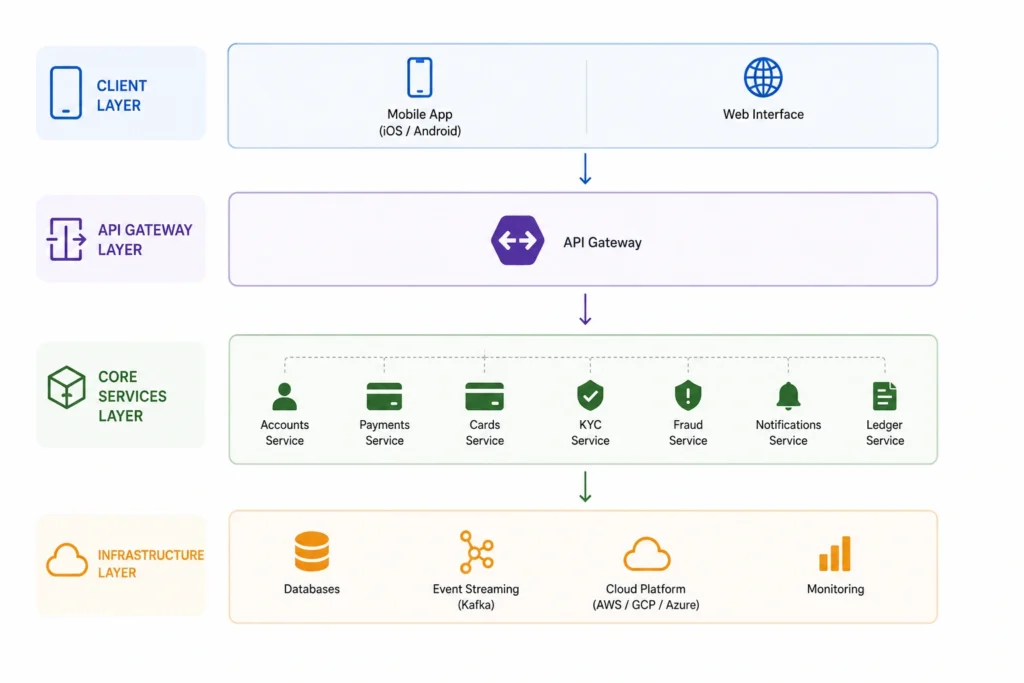
A production-grade neobank architecture covers four layers:
Each microservice in the core layer owns its own data store and communicates through event-driven messaging. This is what allows a neobank to scale individual components independently. The KYC service can be scaled during onboarding peaks without scaling the entire payments service alongside it.
The build vs integrate decision directly determines your development timeline, compliance scope, and long-term cost structure. Building every component in-house is rarely the right approach, and integrating everything limits what makes your product defensible.
The principle is the same across every component: integrate where a reliable, auditable product already exists, and build where the logic is what differentiates your product from every other neobank using the same vendor. The same principle applies across the full product stack, where a custom fintech app earns its cost, precisely where off-the-shelf vendors stop being defensible.
Licensing is the founding decision that determines your compliance architecture, partnership model, and regulatory obligations from day one. In India, three paths are viable depending on your product scope and capital position.
| Licensing Path | How It Works | Requirements | Best For |
|---|---|---|---|
| Full banking licence (Small Finance Bank or Payment Bank) | RBI-issued licence; operate as a licensed bank | Rs 200 crore paid-up capital (SFB); complex multi-year process | Large-scale, well-capitalised operators |
| BaaS via partner bank | Partner with a licensed bank; operate under their licence via API | Technology and compliance agreement with the partner bank | Fastest route to market; suitable for most funded startups |
| NBFC route | Obtain an NBFC licence from the RBI; offer lending and savings products without full banking | Rs 10 crore net owned funds; RBI registration | Fintech products focused on credit, lending, or BNPL |
Most neobank startups in India launch via the BaaS route, partnering with banks like RBL, Yes Bank, or SBM to access account issuance, payment rails, and card issuing under the bank’s regulatory umbrella. The NBFC route is chosen when lending is the primary product and the full banking licence is not required at launch.
Development cost varies significantly by scope, team location, and compliance requirements. The figures below use India-based development rates for the Rs column and blended global rates for the $ column. These figures cover development only and do not include banking licence fees, BaaS partner costs, or ongoing compliance expenses.
| Scope | Development Cost (Rs) | Development Cost ($) | Timeline |
|---|---|---|---|
| MVP (onboarding, accounts, transfers, debit card) | Rs 40 to 80 lakh | $50,000 to $120,000 | 16 to 24 weeks |
| Full-featured (multi-method payments, analytics, support, wallets) | Rs 80 lakh to 1.5 crore | $120,000 to $250,000 | 24 to 40 weeks |
| Enterprise (lending, investments, business accounts, open banking) | Rs 1.5 to 3 crore | $250,000 to $500,000+ | 40 to 60 weeks |
Neobanks sit at the higher end of the mobile app development cost spectrum in India because compliance requirements, security audits, and third-party API integrations add substantial scope beyond standard feature development. A production-grade neobank in India should budget an additional Rs 30 to 60 lakh per year for cloud infrastructure, third-party API fees, and regulatory compliance costs that sit outside the development quote and compound quietly across years two and three, a pattern mapped in detail in the breakdown of hidden costs in fintech app development.
Building a neobank is less about having the right feature list and more about making the right architecture, licensing, and build-vs-integrate decisions at the start. Those decisions compound the right ones, making every subsequent sprint faster and cheaper; the wrong ones surface during compliance audits, scaling events, or licensing transitions.
Zethic builds fintech products and mobile applications where these decisions are made at the architecture stage, before the first line of code is written. The work spans onboarding flows, payment integrations, core banking API layers, and the compliance infrastructure that fintech software development needs from day one. If you are at the planning or scoping stage for a neobank or digital banking product, Zethic is a good place to start.
Zethic Technologies is a trusted Web & Mobile App Development Company providing Custom Software Development Services to startups and growing businesses. We combine planning, development, and long-term thinking to deliver stable digital products.
Let Zethic help you build smarter Not just faster
Sometimes. If the POC was built on clean, scalable architecture, it can seed the MVP, but most POCs are quick experiments and should be treated as throwaway code.
A neobank requires regulatory compliance from day one: KYC, AML, PCI DSS, and RBI guidelines in India alongside real-time transaction processing, multi-party API integrations, and a core banking ledger. Standard app development involves none of these constraints, which is why fintech-specific engineering experience matters at the architecture stage.
Yes. The BaaS route allows a startup to launch under a licensed partner bank’s regulatory umbrella. This is the most common path for funded neobank startups in India and significantly reduces the capital and time requirements of the full banking licence process.
Microservices vs monolith, event-driven vs request-driven transaction processing, and the choice of core banking provider are the three decisions with the highest long-term cost implications. Getting these right at the design stage determines how much it costs to scale, add features, and pass compliance audits.
White-label platforms reduce time to market and compliance scope at the cost of customisation and higher per-transaction fees at scale. Custom neobank app development gives full ownership of the product experience, data, and unit economics. The decision depends on your transaction volume trajectory, product differentiation requirements, and engineering capacity.
Ram brings deep expertise in product strategy and system architecture across fintech, SaaS, and AI platforms. He specializes in pre-execution planning to help teams build scalable technology foundations and avoid costly rebuilds.

Adding {{itemName}} to cart
Added {{itemName}} to cart