


Start Your Project Today
Tell us about your project — we’ll get back within 24 hours


A marketing team searches for a sustainability report example, finds a polished PDF from a well-known company, and copies its tone and layout. The new report reads well, but the numbers inside it were never checked against the systems that actually produced them. A convincing sustainability report example on the page is not the same thing as a credible one behind it.
A genuinely useful sustainability report example does more than look complete. It shows a reader exactly where each figure and each claim actually comes from, not just what the finished page states.
Most reports converge on the same five recurring elements, largely inherited from broader ESG reporting practice, though the balance between them shifts depending on company size and audience. A first-time reporter might keep the narrative brief, while a company under formal assurance needs more detail behind every figure.
The table below reflects what a corporate sustainability report example typically needs across those five elements, along with the internal source each one should be able to point back to.
| Report Element | What It Demonstrates | Where the Data Comes From |
| Executive Summary | Ties the report’s key results to the business’s stated priorities | Compiled from every other section once drafted |
| Emissions and Energy Data | Specific, verifiable figures rather than general statements | Facilities, utility billing, and operations systems |
| Workforce and Diversity Data | Measurable progress against stated goals | HR and payroll systems |
| Case Studies and Narrative | Concrete examples connected back to the reported metrics | Interviews with program leads and internal records |
| Targets and Progress | Year-over-year comparison against previously stated goals | The company’s own prior reports and internal tracking |
Consider a composite example drawn from common industry practice rather than any single real company. A mid-size consumer goods manufacturer might open its emissions section with a specific figure, then follow it immediately with the context behind that number.
An annual sustainability report example built this way treats each section as a small, self-contained argument rather than a list of facts. Every figure earns its place by answering the question a reader would naturally ask next, usually because a prior sustainability consulting exercise already identified which questions mattered most to ask.
A representative sentence might read: “Total Scope 1 and 2 emissions (direct emissions and purchased energy) for the reporting year were 24,680 metric tons of carbon dioxide equivalent, a reduction of 12 percent from the prior year following the completion of a facility-wide lighting retrofit.” That single sentence states the figure, compares it to a prior baseline, and names the specific action behind the change.
A workforce section in the same report might follow the same pattern: “Women held 38 percent of managerial roles at year-end, up from 34 percent the previous year, following the rollout of a structured internal promotion process.” That pattern, a number, a comparison, and a named cause, repeated section to section is what separates a credible example from a generic one.
The same pattern extends to governance and community sections too. A governance paragraph naming the specific committee responsible for an oversight decision reads as more credible than one describing oversight in general terms, and the same is true of a community section that names a specific program rather than describing community involvement broadly. Readers, and eventually assurance providers, tend to trust specificity over general assurances of good intent.
The finished report is the last stage of a much longer process, and copying its prose style says little about whether the figures in a new report will prove accurate the same way. A borrowed sentence structure cannot supply data a company has not yet collected.
Two companies in the same industry can arrive at very different report content even when they follow a similar structure, since their materiality assessments, data systems, and prior year baselines rarely match. Copying the visible output skips over all three of those differences. This is true whether the source being copied is a full sustainability report sample or just a single ESG report example pulled from one section of a competitor’s disclosure.
External assurance makes this visible: 79 percent of FTSE 100 companies now obtain some form of independent assurance over their reported ESG metrics, up from 75 percent in 2021. An assurance provider checks the data behind the sentence, not the sentence itself, which is exactly the part a copied example cannot provide.
For a business evaluating any sustainability report example as a model, the real question is not whether the writing sounds professional. It is whether the company publishing it could show an auditor exactly where each number originated, on request, and whether a new company copying the format could answer the same question about its own figures.
A report built once from a good example can still work as a starting point, provided the numbers inside it get connected to a live source before the next cycle begins through a proper data engineering effort. The prose and structure can stay largely the same year to year.
What changes is where each figure gets pulled from. A number typed once from an email attachment has no record of its origin a year later, while the same number pulled from a connected system carries that origin with it automatically. The visible page barely changes; what sits behind it does.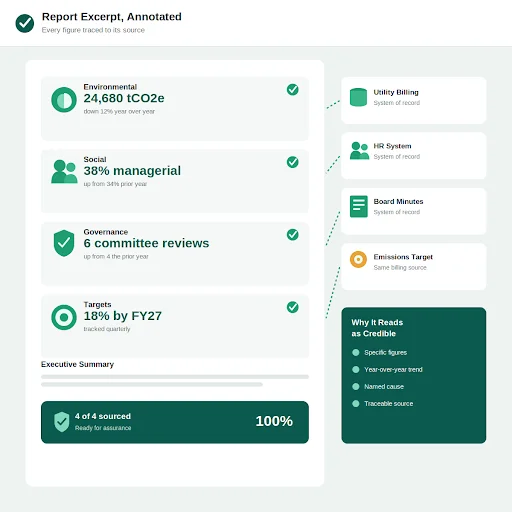
That connection is what lets a business publish its second and third reports with the same credibility as the first, rather than starting the sourcing work over from nothing each time. Over several cycles, the effort shifts almost entirely from writing to maintaining the data connections themselves.
Building a credible sustainability report starts with the data behind it, not the prose in front of it. Zethic designs custom software that connects a company’s existing systems to its report, so every figure traces back to a source an assurance provider can actually check. Businesses starting from a sustainability report example they found online can begin by testing whether their own data could support the same sentences, section by section.
Ram brings deep expertise in product strategy and system architecture across fintech, SaaS, and AI platforms. He specializes in pre-execution planning to help teams build scalable technology foundations and avoid costly rebuilds.
