A company builds a dashboard that tracks emissions, energy use, and workforce diversity, publishes it, and calls the result its sustainability report. Investors are satisfied, but employees, customers, and community partners looking for the human side of the story find only numbers. Sustainability reporting was never meant to be just an ESG dashboard with a cover page.
What Does Sustainability Reporting Actually Mean?
Sustainability reporting is the practice of disclosing an organization’s economic, environmental, and social performance, paired with the reasoning behind its choices, not just the resulting numbers. The practice predates the term ESG by more than two decades:
GRI, the standards body most large companies still turn to today, was founded in 1997 in Boston, in response to the Exxon Valdez oil spill, and published the first global sustainability reporting guidelines in 2000.
That history shapes what a sustainability report is still expected to contain today. It combines quantitative metrics with qualitative narrative, mission, materiality, and input from the people affected by the business, in a way a pure ESG report does not require.
A report that only lists emissions figures and a diversity ratio has produced ESG data, not a sustainability disclosure in the fuller sense the term originally implied. The narrative half, why those numbers matter, what the business is doing about them, and who is affected, is not optional decoration. It is the part of the practice that gave sustainability reporting its name in the first place.
How Is Sustainability Reporting Different From ESG Reporting and CSR?
The three terms are often used as synonyms, but they answer different questions for different audiences. Knowing which one a request is actually asking for keeps a reporting team focused on the document that was actually requested.
Sustainability reporting sits in the middle of the three, broader than
ESG reporting‘s investor focus, but more structured and standardized than CSR reporting’s largely voluntary approach. A company asked for “our sustainability report” that delivers only an ESG data sheet has technically answered a narrower question than the one it was asked.
| Term |
Primary Audience |
Content Type |
| Sustainability Reporting |
Employees, customers, communities, and investors |
Mixed narrative and data |
| ESG Reporting |
Investors and financial analysts |
Primarily quantitative metrics |
| CSR Reporting |
General public and local communities |
Primarily narrative, voluntary |
A company reporting to a single audience can often use these terms loosely with little practical consequence. One reporting to investors, regulators, and the public at the same time usually needs to be explicit about which document is which, since each audience tends to expect a different one, and conflating them means at least one audience gets something other than what it expected.
What Does a Complete Sustainability Reporting Process Look Like?
A full sustainability reporting cycle starts well before anyone drafts a page. It begins by identifying which topics matter to the business and the people it affects, then moves through data collection and narrative writing before anything is published.
Skipping the first step is common, and it shows. A report built without a genuine materiality assessment tends to cover whatever data was easiest to collect rather than what the business’s own audiences actually care about, which is usually obvious to anyone reading it closely. Companies doing GRI reporting in particular are expected to document how their materiality assessment was actually conducted, not just state its conclusions.
- Materiality assessment, often supported by sustainability consulting, to identify which topics matter most to the business and its audiences
- Data collection across emissions, workforce, and governance metrics
- Narrative drafting covering programs, case studies, and the context behind the numbers
- Internal review and, increasingly, external assurance
- Publication and distribution to the intended audiences
Each stage depends on the one before it, which is why skipping steps early in the cycle tends to become visible once the report reaches its intended readers.
Why Do Most Sustainability Reports Still Read Like Two Separate Documents?
The data half of a sustainability report usually comes from a system: a spreadsheet, a dashboard, an ESG platform. The narrative half usually comes from a person, a sustainability lead interviewing program managers, writing up case studies, and describing why a target was set.
Those two halves are rarely built by the same team on the same timeline, which is why so many sustainability reports read like a data appendix attached to a separate narrative.
Both halves are usually built well on their own. What matters is the boundary between them, the moment a late data correction lands after the narrative describing that same metric has already been written and approved, and no one returns to check whether the story still matches the number.
- Data teams and communications teams often work from different source files entirely
- Case studies and program descriptions get written months before the final numbers are locked
- Later data corrections rarely make it back into narrative sections that already referenced the old figures
- Design and layout happen last, forcing both halves into a shared template that neither was built for
- Each year’s report restarts the coordination process from scratch
Both sides are putting in real effort, on two separate workflows: one built around numbers and one built around people. The two come together most smoothly inside an
ESG report template whose fields draw from a live data source rather than a retyped copy.
What Should a Modern Sustainability Reporting Process Actually Connect?
A reporting process that stays connected links the data side and the narrative side to the same underlying record, so a case study and the metric it references stay consistent even after a late correction. This is a
data engineering task at its core: instead of a spreadsheet feeding one team and a set of interview notes feeding another, both draw from the same source.
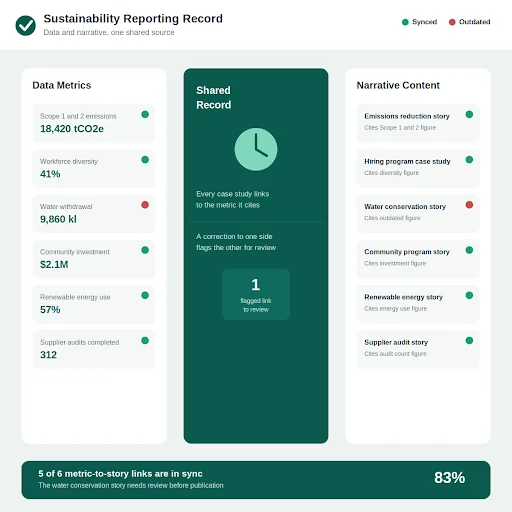
That connection matters most in the weeks before publication, when data changes are common and narrative sections need to reflect whatever the final numbers turn out to be. A system built this way also makes the next year’s materiality assessment easier, since the prior cycle’s data and narrative are already stored together rather than scattered across whoever happened to hold them last.
How Can Businesses Build a Sustainability Reporting Process That Stays Connected Across Teams?
Coordinating data and narrative across teams ultimately comes down to systems design, not writing.
Zethic designs custom software that keeps a business’s reporting data and supporting content connected to the same source record, so a late correction to one number does not leave the surrounding narrative out of date. Businesses currently coordinating their sustainability report across separate spreadsheets and documents can start by mapping where the two halves currently sit apart, since that mapping usually points directly at where the process needs the most work.