


Start Your Project Today
Tell us about your project — we’ll get back within 24 hours

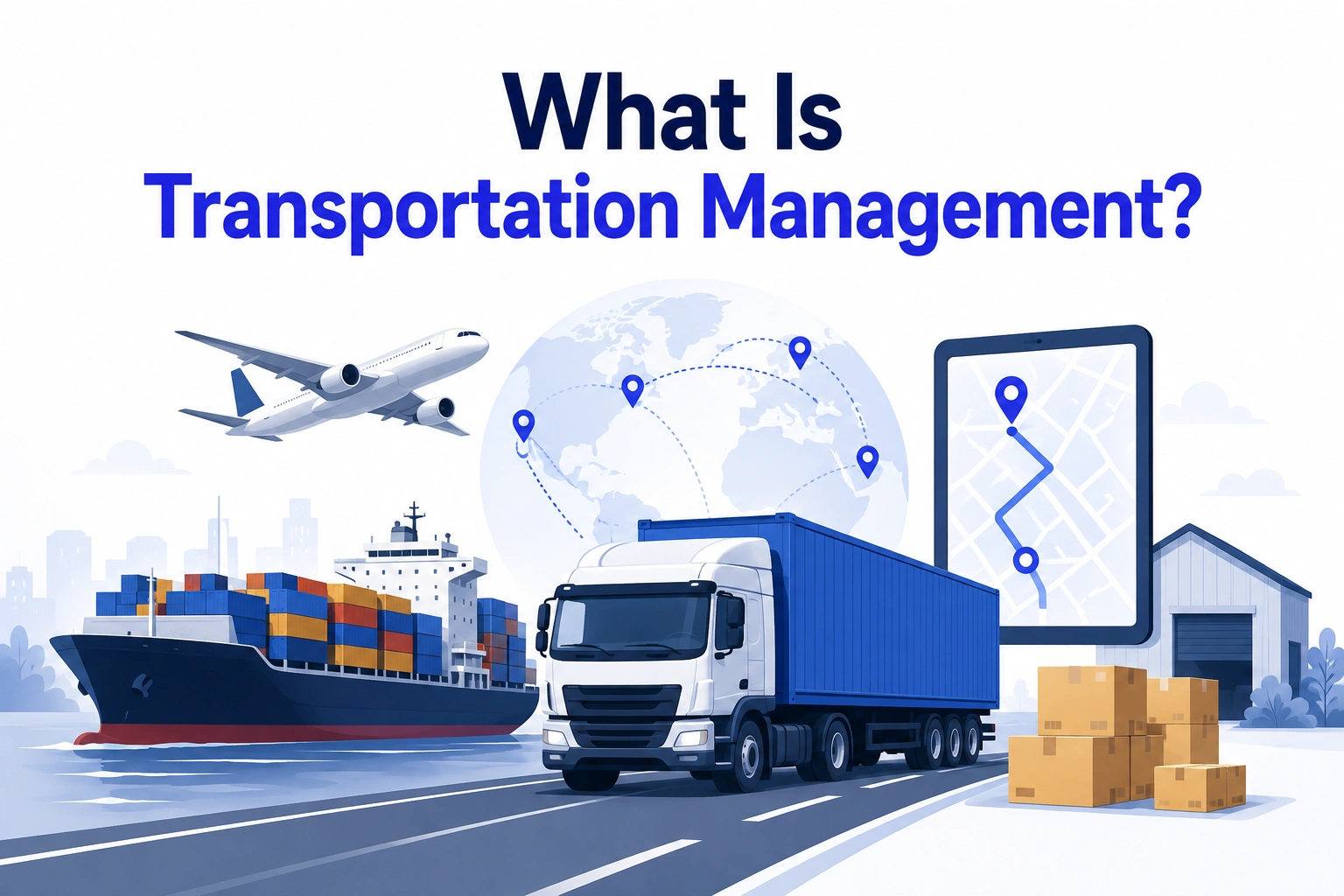
Transportation management is the business function of planning, executing, and tracking the movement of goods from origin to destination, usually run through a transportation management system (TMS) that automates carrier selection, routing, and freight documentation. It sits alongside warehouse and supply chain operations rather than replacing either one.
Most explanations jump straight to describing TMS software and skip the underlying discipline entirely, which leaves business decision-makers unclear on what they’re actually buying software to support. The function existed as a coordination practice long before software automated it, and understanding that distinction matters when scoping a system, since the software should fit the function rather than define it.
A TMS is the software layer that automates that coordination work: it takes the planning and decisions a transportation manager used to handle manually and turns them into a repeatable digital process. The system centralizes shipment data, carrier contracts, and route history so decisions get made from current information rather than scattered spreadsheets and phone calls.
Most TMS platforms sit between a warehouse management system, the ERP, and the carrier network, pulling order data from one side and sending booking instructions to the other. Most write-ups on this topic stop at a feature checklist; the more useful question is which of those features actually determine fit for a specific carrier mix and compliance load, which is what the sections below walk through. For a growing business, this coordination work stops being a spreadsheet exercise the moment shipment volume makes manual tracking too slow to keep up with demand.
Every serious TMS platform is built around a consistent set of modules, the kind of foundation that mature transport software development is built on regardless of vendor or industry. These features work together rather than in isolation, since a gap in one usually shows up as a cost or delay in another.
Freight and carrier management is the part of this discipline concerned with who actually moves the goods, not just how the route gets planned. It covers onboarding carriers, negotiating rates, and tracking each carrier’s reliability across lanes and load types.
A business running multiple carriers needs a system that can compare rates in real time and route bookings to whichever carrier fits a given shipment’s cost, speed, and capacity requirements. Without that layer, carrier selection tends to default to habit rather than the best available option, and cost creep follows quietly over time.
Route optimization takes a set of shipments, stops, or delivery points and calculates the sequence and path that minimizes distance, time, or fuel cost while respecting real constraints like delivery windows and vehicle capacity. This is a core function of last-mile delivery software. It’s one of the more measurable cost levers in freight operations because the savings show up directly in fuel and labor hours.
Modern route optimization also adjusts in near real time as conditions change, rerouting around traffic or a delayed pickup rather than sticking to a static plan built the night before. That responsiveness is what separates a route optimization module from a one-time route planning spreadsheet.
Transportation management software costs in India vary by deployment model, carrier network size, and whether the system needs custom integration with an existing WMS or ERP. These ranges reflect production-grade builds for mid-size logistics and manufacturing operations.
| TMS Type | Typical Cost Range (INR) | Timeframe |
| Cloud-based TMS, single carrier network | ₹3,00,000 – ₹8,00,000 | 4–6 weeks |
| Multi-carrier TMS with rate comparison | ₹8,00,000 – ₹20,00,000 | 8–12 weeks |
| Route optimization module (add-on) | ₹4,00,000 – ₹10,00,000 | 4–8 weeks |
| Custom TMS with WMS/ERP integration | ₹20,00,000 – ₹50,00,000 | 12–20 weeks |
| Enterprise multi-modal TMS (road, rail, air) | ₹50,00,000+ | 5–8 months |
Costs climb fastest when a business needs the TMS to integrate with an existing WMS or ERP rather than run standalone, since that integration layer is exactly the kind of work a logistics software development company scopes carefully before writing any code. Demand for TMS platforms has grown steadily worldwide as more businesses shift from manual coordination toward automated systems, a pattern that shows up in India’s logistics sector as shipment volumes scale. As that volume grows, compliance automation becomes as important to system fit as carrier selection, since a platform that handles freight well but ignores regulatory documentation just moves the bottleneck downstream.
Any TMS moving goods across Indian state lines needs to account for the e-way bill requirement, a compliance document mandated under GST rules whenever a consignment’s value crosses ₹50,000 for inter-state movement. Interstate shipments above that threshold need a valid e-way bill before the vehicle can move.
A TMS that generates e-way bills automatically as part of the booking workflow avoids the delays and penalties that come from a transporter carrying goods without one. This matters more as shipment volume grows, since manually generating bills for every consignment becomes a bottleneck in its own right.
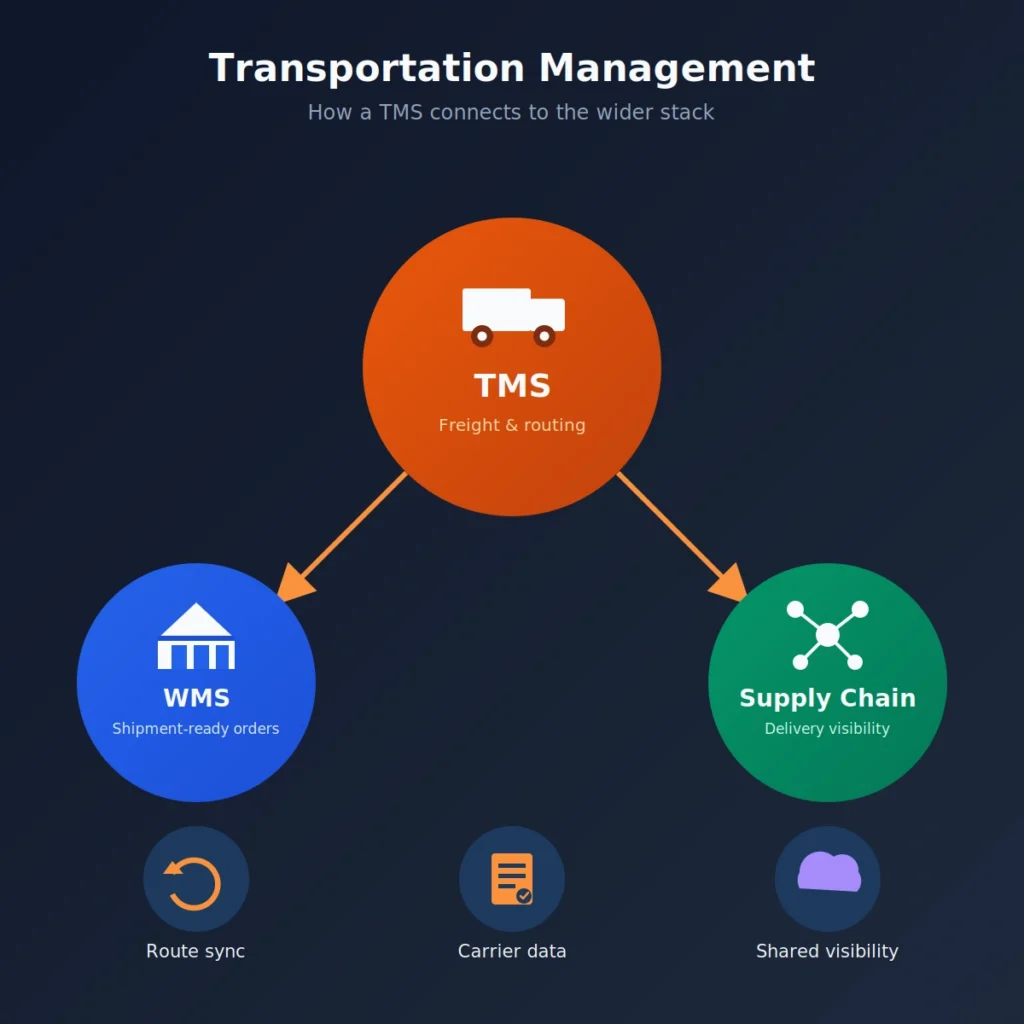
A TMS rarely operates as a standalone system. It typically sits downstream of the warehouse, pulling shipment-ready orders the moment picking and packing finish, and upstream of the broader supply chain view that tracks goods until delivery.
That connection point is where a lot of the practical value shows up: a warehouse that knows which carrier is arriving and when can time dock assignments accordingly, and a supply chain team gets delivery visibility straight from the supply chain management software that already tracks the shipment end to end. The tighter that link, the less manual reconciliation everyone downstream has to do.
Getting this right starts with mapping actual shipment volume, carrier mix, and compliance needs before picking a platform, rather than buying features a business doesn’t yet need. The businesses that get the most value treat it as connected infrastructure from day one, not a bolt-on after the warehouse and order systems are already running.
Zethic builds TMS platforms that plug into a business’s existing warehouse and order data rather than operating as a disconnected booking tool. The team scopes carrier integrations and route optimization logic around how freight actually moves for that business, which is the kind of groundwork Zethic treats as the starting point rather than an afterthought.
Ram brings deep expertise in product strategy and system architecture across fintech, SaaS, and AI platforms. He specializes in pre-execution planning to help teams build scalable technology foundations and avoid costly rebuilds.
