

Why Does Digital Transformation in Healthcare Fail So Often?
Healthcare Digital Transformation
Healthcare Software Development
Healthcare App Development
Healthcare Integration Solutions
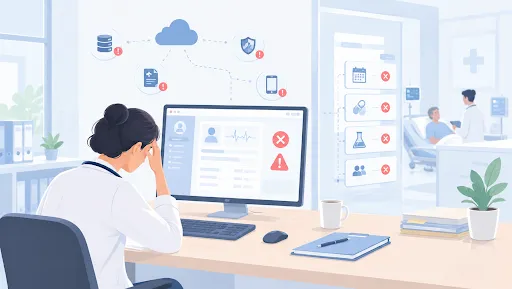
Hospitals keep investing in new platforms, yet clinicians often go back to spreadsheets and paper notes within months of a rollout. Digital transformation in healthcare promises faster care and lower costs, but the technology is rarely the reason it stalls. The real obstacles are poor workflow fit, late compliance reviews, and unclear change management.
What Is Digital Transformation in Healthcare?
Digital transformation in healthcare means redesigning how care is delivered, documented, and paid for using digital tools, not just converting paper charts into PDFs. It covers electronic health records, telemedicine, remote monitoring, and AI-assisted diagnostics working together instead of as separate add-ons. The goal is connected care, where a patient’s data follows them across every provider they see.
This is different from basic digitization, which moves a paper process onto a screen, as when a hospital scans charts into PDFs. A hospital where a cardiologist, a pharmacist, and a remote monitoring team share live patient data has gone through digital transformation. This distinction shapes how a healthcare software development project gets scoped from the very first conversation.
Why Do Digital Transformation Projects Fail in Healthcare?
Most healthcare digital transformation projects fail for organizational reasons, not technical ones. Clinicians are often brought in after the software is already chosen, so the tool clashes with their existing workflow instead of fitting it. Legacy systems rarely exchange data cleanly, which means new platforms get added on top of old data silos instead of replacing them.
- Clinical staff were not consulted before the rollout, so adoption stays low
- Legacy systems and new platforms cannot exchange data cleanly
- Compliance and security reviews get added late, delaying go-live
- Leadership treats the rollout as an IT project instead of a care delivery change
- Success criteria are never clearly defined, so no one can say whether it worked
Reported failure rates for these projects vary widely across studies, often depending on how each report defines success. What stays consistent across nearly every account is that the failures cluster around people and process, not the underlying software.
What Are the Benefits of Digital Transformation in Healthcare?
When digital transformation in healthcare works, it changes both clinical outcomes and daily operations. India’s national health mission shows the scale that is possible: more than 90 crore Ayushman Bharat Health Accounts now link patient records across providers under the Ayushman Bharat Digital Mission. Connected data lets a care team catch problems earlier, because information from every visit and device sits in one place instead of scattered across systems.
- Faster, more accurate diagnoses from consolidated patient data
- Fewer duplicate tests and lower administrative overhead
- Shorter wait times through online scheduling and digital intake
- Better chronic disease management through remote monitoring
- Clearer audit trails for regulatory and compliance reporting
These benefits compound over time. A hospital that moves intake and billing onto digital workflows frees staff hours for patient care instead of paperwork.
What Are Examples of Digital Transformation in Healthcare?
The clearest examples of digital transformation in healthcare sit in day-to-day patient contact rather than back-office systems alone. Telemedicine platforms now handle routine consultations, follow-ups, and specialist referrals without requiring a hospital visit.
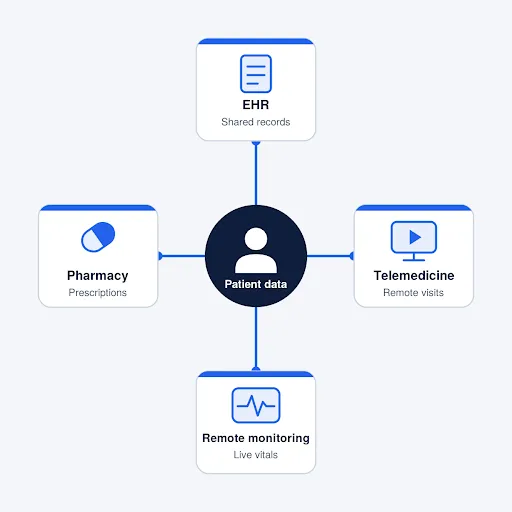
- Electronic health records shared across primary care, specialists, and pharmacies
- Remote patient monitoring for chronic conditions like diabetes and heart failure
- AI-assisted imaging review that flags cases for radiologist priority
- Patient portals for appointment booking, lab results, and billing
- Digital intake and triage through mobile apps
Many of these patient-facing examples start as a focused healthcare mobile app development project built around one task, such as scheduling or intake, before expanding into full EHR integration. Each still depends on the same thing: systems that can share data with each other, not just store it well on their own.
How Much Does Digital Transformation Cost in Healthcare?
The cost of digital transformation in healthcare depends heavily on scope. A single EHR upgrade costs far less than a full interoperability overhaul across a hospital network, and smaller clinics can start with targeted tools before taking on larger systems.
Project Scope | Typical USD Range | Typical INR Range |
|---|---|---|
Patient portal or online scheduling | $25,000 to $75,000 | ₹20 lakh to ₹60 lakh |
EHR integration for a single clinic | $80,000 to $250,000 | ₹65 lakh to ₹2 crore |
Telemedicine platform with EHR sync | $150,000 to $400,000 | ₹1.2 crore to ₹3.3 crore |
Hospital-wide interoperability overhaul | $500,000 and up | ₹4 crore and up |
These ranges assume custom development. Off-the-shelf tools cost less upfront but often need costly changes later to meet the compliance and interoperability needs specific to healthcare. Most hospitals arrive at a firmer number by scoping digital transformation services against one department’s workflow, rather than estimating from an industry-wide average.
How Should Hospitals Plan a Digital Transformation?
The organizations that succeed treat digital transformation in healthcare as a clinical change program with technology attached, not the reverse. They involve nurses, physicians, and administrative staff in choosing and testing tools before a single department goes live.
- Map the actual clinical workflow before selecting any software
- Pilot with one department or site before a full rollout
- Build interoperability and compliance requirements in from day one
- Assign a single owner accountable for adoption, not just implementation
- Track specific, measurable outcomes like wait time or documentation time saved
Teams hold onto this order more reliably when it is written down as a digital transformation framework everyone can reference, rather than relying on good intentions alone. The vendor chosen matters less than the sequence the rollout follows.
How Can Healthcare Organizations Get Digital Transformation Right?
Getting digital transformation in healthcare right comes down to sequencing: clinical workflow first, compliance and interoperability built in early, and technology chosen to fit both.
Zethic builds healthcare software by mapping clinician workflows before writing a single line of code. That puts interoperability and compliance requirements into the architecture from day one. It works with hospitals and clinics through this kind of phased rollout, starting with one department’s real problem instead of a system-wide relaunch.