


Start Your Project Today
Tell us about your project — we’ll get back within 24 hours

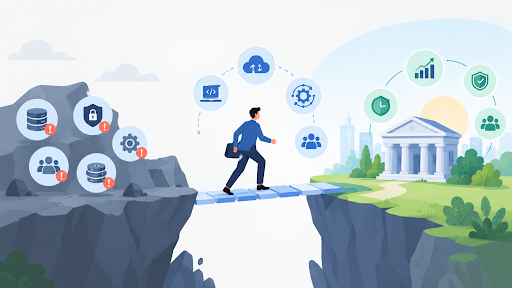
A team picks the tools, sets the launch date and expects the benefits to follow. The obstacles that shape the result sit outside the software: unclear ownership, uneven skills, and older systems that resist change. Digital transformation challenges rarely arrive one at a time, so resolving them in the right order matters more than tackling each in isolation.
Digital transformation challenges are the obstacles that slow a project that changes how a business operates through digital technology. They fall into a few repeating groups, and most projects meet several of them at once.
These groups feed into one another. Limited training slows adoption, slow adoption delays the data that would prove the return, and a late return weakens the case for more budget. Naming each group at the start makes the work easier to scope with digital transformation services or an internal team.
Digital transformation fails when a challenge goes unnamed for long enough to shape the decisions around it. The pattern repeats across industries: the technology works, but the people, data and budget around it have not caught up.
| Challenge | How It Stalls a Project | Early Warning Sign |
| Ownership | Decisions wait for someone with no authority to settle them | The same question returns to every weekly meeting |
| Skills | New tools launch while daily work stays the same | Teams keep a spreadsheet running beside the new system |
| Legacy systems | New features depend on old components that change slowly | Simple requests take weeks because of manual workarounds |
| Data | Reports disagree, so leaders hesitate to act on them | Two teams quote different figures for one metric |
| Budget and returns | Funding stops before results become visible | Nobody can state the target figure for the project |
| AI adoption and security | Pilots stay small because risk reviews arrive late | Security sign-off is requested after the build |
None of these starts with the technology itself. Each sits in the way the business decides, trains, connects, and funds around it. Teams that want an outside view on the AI and security challenge can start with AI consulting services before a pilot begins.
Benefits arrive when the challenges are resolved together, not one by one. A project that settles ownership but leaves data scattered takes longer to show a result, because each benefit leans on at least one other group of challenges. Leaders who see this early set expectations around a sequence of gains instead of one launch-day result.
Each benefit traces back to one challenge that has to be resolved first:
This is why order matters. Resolving a challenge out of sequence delays the benefit that depends on it, while resolving it early gives leaders a result to point to when budgets come up for review.
AI adds a new layer to each challenge rather than a separate one. A pilot that works in a demo still needs consistent data, named owners, and trained users before it reaches daily work.
Treating AI as part of the same sequence keeps these checks from arriving late and lets a business add AI to a project that already has an owner and a baseline. Under India’s Digital Personal Data Protection Rules, obligations phase in over 18 months, which gives teams time to build consent and breach-response checks into the design stage.
A short diagnostic shows where to look first. Answer each question for one live project and note which ones raise a doubt.
Two or more doubts in the same group point to the challenge to resolve first. A single doubt is usually a simple fix, such as naming an owner or agreeing on a metric. Mapping the answers onto a digital transformation framework shows which component needs attention first.
Order matters because some challenges block others. Ownership comes first, since every later decision needs someone with the authority to make it. Treating the sequence as a step-by-step digital transformation process keeps each phase tied to the evidence from the one before it.
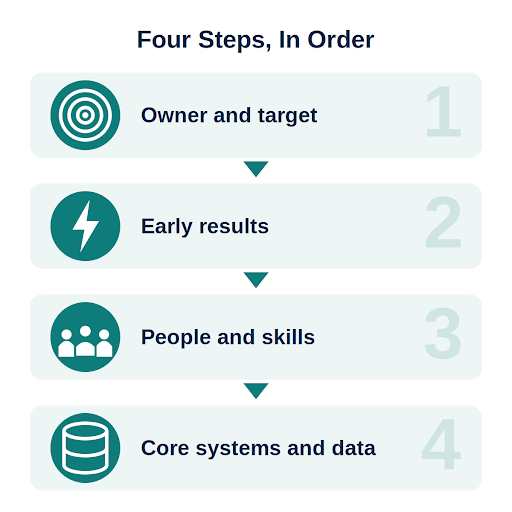
Size changes the starting point. Smaller businesses can follow the same four steps with fewer systems to connect, which makes the first results easier to show. Larger organizations can run the steps in parallel across several teams, with one owner coordinating the baseline for each.
Digital transformation challenges are linked, so the route to the benefits runs through naming an owner, fixing the data and training teams in an order that builds evidence. Businesses that treat the obstacles as one connected set find the benefits easier to show and easier to keep.
Zethic runs a short diagnostic across ownership, data and skills at the start of a project, sequences early results ahead of legacy system changes, and writes a baseline figure into every phase. That gives leadership a clear view of what changed at each step and which challenge to address next.
Ram brings deep expertise in product strategy and system architecture across fintech, SaaS, and AI platforms. He specializes in pre-execution planning to help teams build scalable technology foundations and avoid costly rebuilds.
