- AI
Artificial Intelligence
Emerging Tech
- Products
AI, Marketing & Sales
Financial Services
Banking
Logistics & Mobility
- Services
Strategy & Innovation
Intelligent Engineering
Partner to Scale
Have a project in mind?
- Industries
FinTech & Banking
Logistics & Supply Chain
Practice spotlight
- ROI Calculator
- Company

- 8 MIN READ
- Views: 12
Build vs Buy Software: How Do You Decide What's Right?
By Ram Nethaji
Founder
FinTech app development cost
User Interface Design
Custom software development
FinTech app development services
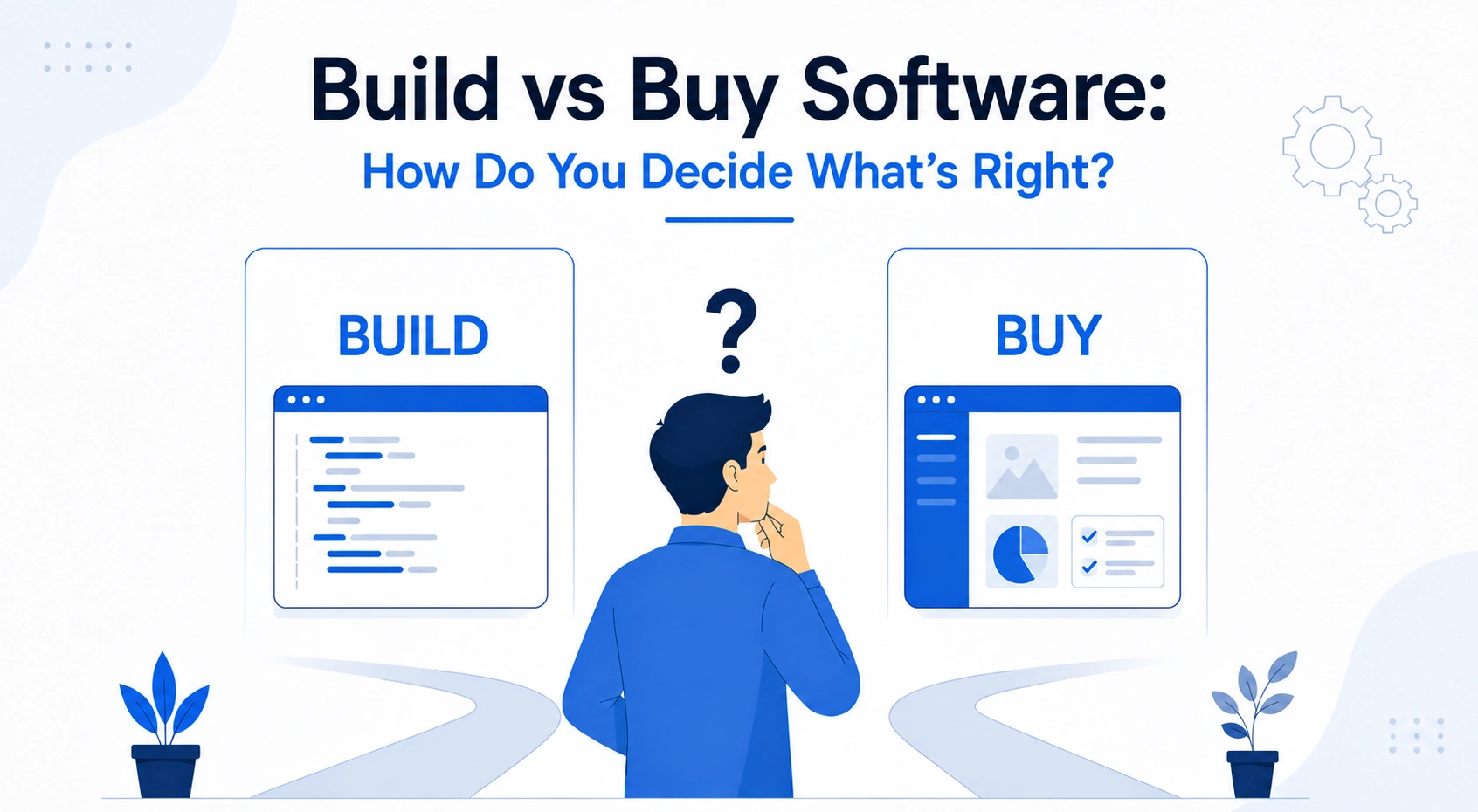
Build vs buy software comes down to one trade-off: control and long-term ownership versus speed and lower upfront cost. Building fits when the software is your competitive edge, and buying fits when the function is standard across your industry. The right call depends on your budget, timeline, and how central the workflow is to your business.
What Is Build vs Buy Software?
Build vs buy software describes the choice between developing a custom application from scratch or purchasing an existing solution such as a SaaS product. Building gives a company full ownership of the code, data, and architecture. Buying means adopting a vendor’s product and working within its features and limits.
A third path, hybrid, has become common. It means buying a flexible platform with a strong API and building custom extensions on top of it. Most mid-size businesses end up somewhere between the two extremes rather than at either pole.
When Should You Build Custom Software?
Building custom software makes the most sense when the software itself is a source of competitive advantage rather than a commodity business function, or when regulatory, security, or data governance requirements make off-the-shelf solutions unsuitable. Businesses evaluating fintech app development, for example, often choose custom development when compliance demands greater control over how sensitive data is processed, stored, and audited.
- Competitive differentiation: The workflow or product experience is central to your business and cannot be easily replicated with standard software.
- Limited SaaS fit: Available software requires extensive workarounds or compromises to support your business processes.
- Compliance and data governance: Regulatory obligations, audit requirements, or customer contracts require greater visibility and control over data handling.
- Complex integrations: Existing legacy systems or proprietary applications cannot be integrated effectively using standard connectors or APIs.
- Long-term economics: At higher usage levels, the total cost of owning a custom solution over several years may become more favorable than recurring subscription and licensing fees.
- Avoiding vendor lock-in: The business requires flexibility to modify features, integrations, or infrastructure without being constrained by a third-party platform’s roadmap or pricing.
When Should You Buy Off-the-Shelf Software?
Buying software makes the most sense when the required functionality is standardized and does not provide a competitive advantage. In these cases, faster deployment, lower upfront investment, and vendor-managed maintenance often outweigh the benefits of building a custom solution.
- Standard business function: The requirement is common across the industry, such as payroll, CRM, accounting, or email marketing.
- Fast time to market: The business needs a working solution within weeks rather than waiting for a custom development project.
- Limited upfront budget: Capital for a custom software build is unavailable or better allocated to core business activities.
- Strong product fit: An existing software product satisfies most business requirements without significant customization or workarounds.
- Vendor-managed maintenance: The business prefers the software vendor to handle updates, security patches, infrastructure, and ongoing support.
- Process validation: The goal is to validate a workflow or business model before investing in a long-term custom solution.
Why Is Hybrid the Option Most Teams Miss?
Hybrid is not a compromise so much as a separate strategy within the build vs buy software decision: buy a platform with a strong integration layer for the standard function, then build custom features on top for the parts that matter most.
A common example is buying a CRM platform for lead and contact management, then building a custom reporting layer that reflects the business’s own sales process. This gives speed on the standard part and control where it matters most. A logistics team weighing delivery management software often ends up buying the core platform, then building the dispatch features specific to its own routes.
Hybrid tends to work best when only one or two processes truly need customization, while the rest are standard. It avoids the cost of building everything and the rigidity of buying everything.
What Does a 5-Year Cost Comparison Actually Look Like?
Comparing software costs based only on the first year can be misleading. Subscription fees under a buy model continue throughout the life of the software, while a custom build typically involves a higher upfront investment followed by lower recurring costs for maintenance and enhancements.
The table below provides an illustrative five-year total cost of ownership (TCO) comparison for a mid-sized business application, including implementation, integration, and training. Actual costs vary based on project scope, licensing, infrastructure, and support requirements.
Table: Illustrative 5-year cost of ownership
| Cost factor | Build (India team) | Buy (SaaS) | Hybrid |
|---|---|---|---|
| Year 1 setup | ₹25L to ₹45L | ₹1L to ₹5L | ₹8L to ₹18L |
| Annual cost (Years 2–5) | ₹6L to ₹10L | ₹10L to ₹18L | ₹7L to ₹12L |
| Integration and training | ₹2L to ₹4L | ₹2L to ₹3L | ₹3L to ₹5L |
| Approx. 5-year total | ₹51L to ₹89L | ₹53L to ₹95L | ₹51L to ₹83L |
SaaS costs often increase over time as user counts, storage, and premium features grow. By contrast, custom-built software concentrates more of the investment in the initial implementation, with recurring costs primarily covering maintenance, infrastructure, and incremental enhancements. For organizations expecting significant growth, evaluating the total cost of ownership over several years can provide a more accurate basis for comparison than focusing solely on the initial implementation cost. A payment orchestration layer is one example where long-term economics may shift as transaction volumes increase.
How Do You Decide on Build vs Buy Software?
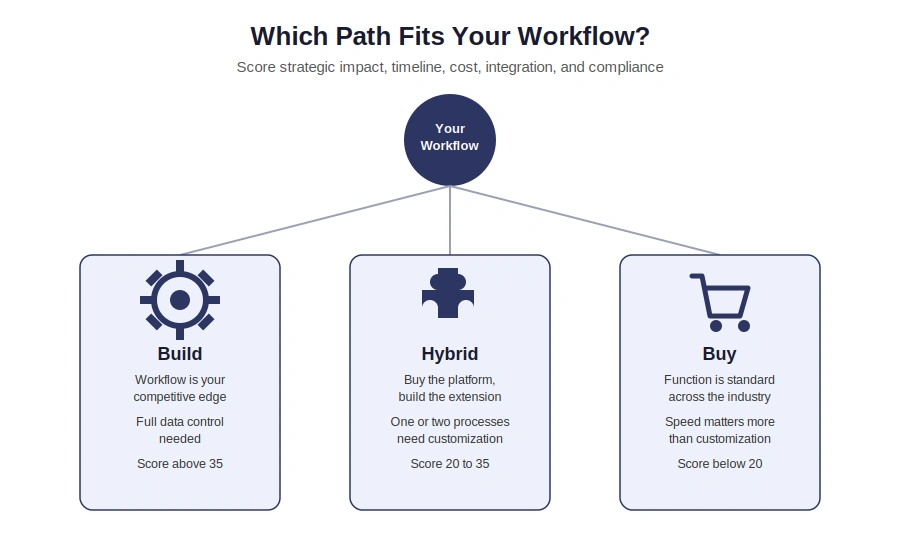
A structured framework prevents personal preference from driving the decision. Score each factor from 0 to 10 based on how strongly it applies to your situation.
- Strategic impact: does this workflow set your business apart from competitors
- Time to market: can the business wait months for a build, or does it need a solution in weeks
- Five-year cost: which option is more affordable once recurring fees and maintenance are included
- Integration complexity: how many existing systems does this need to connect with
- Compliance and data control needs: does the business need direct oversight of where and how data is processed
Add the scores together. Above 35 generally points toward building, 20 to 35 suggests hybrid is worth exploring, and below 20 buying is usually the more practical choice. Growing teams often run this scoring exercise alongside a custom software development company in Bangalore before committing budget to either path.
Does India's Data Protection Law Change the Answer?
India’s Digital Personal Data Protection (DPDP) Act, 2023 is more flexible on cross-border data transfers than many businesses expect when evaluating a build-versus-buy software strategy. Under the provisions relating to processing of personal data outside India, personal data may generally be transferred outside India unless the Central Government specifically restricts transfers to certain countries.
However, the Act continues to place primary compliance responsibilities on the organization that determines how personal data is processed. These responsibilities include obtaining valid consent where required, implementing appropriate security safeguards, notifying relevant authorities and affected individuals of qualifying personal data breaches, and remaining accountable for how service providers and subprocessors handle personal data.
Sector-specific regulations may impose additional requirements. For example, the Reserve Bank of India’s payment data storage requirements require payment system operators to store end-to-end payment transaction data only on systems located in India, while permitting limited overseas processing subject to RBI’s prescribed conditions.
For businesses operating in payments, banking, or other highly regulated industries, these sector-specific requirements often have a greater influence on the build-versus-buy decision than the DPDP Act itself. For many organizations outside these sectors, either a custom-built solution or a SaaS product can support DPDP compliance, provided appropriate contractual, technical, and operational safeguards are in place.
How Do You Move Forward With This Decision?
The build-versus-buy decision is not one that businesses make only once. As markets evolve, software vendors change their pricing and capabilities, and internal priorities shift, it is often worth reassessing whether the original approach still delivers the best long-term value.
Begin by mapping the business workflow you want to support, evaluating factors such as strategic importance, customization needs, integration complexity, compliance requirements, and total cost of ownership. Involving both business and technical stakeholders early helps ensure the chosen approach aligns with operational goals as well as technical realities. Working with an experienced custom software development services partner during the planning stage can also uncover integration, scalability, and compliance considerations before development begins.
At Zethic, we help businesses evaluate both build and buy options by assessing workflows, long-term business objectives, and technical requirements before recommending the most suitable approach. This structured planning process helps organizations make informed investment decisions before committing to software development.
Let Zethic help you build smarter Not just faster
Frequently Asked Questions
Is building always more expensive than buying software?
Not always. Building has a higher upfront cost, but buying can become more expensive over five years once user counts and add-on fees grow, especially for core systems used company-wide.
How long does it typically take to build custom software?
Timelines vary by scope and team size, but a mid-size business application typically takes four to nine months, while smaller MVPs can launch faster.
What is the most common mistake in this decision?
Comparing only the first-year cost of buying against the total cost of building, which ignores how licensing fees compound over several years.
Can a business start with SaaS and switch to custom later?
Yes, and it is a common path. Many businesses buy a standard tool early, then move to a custom build once the process becomes central enough to justify the investment.
Does data compliance always require building software in-house?
Salary is what the developer takes home; the billing rate a client pays includes the vendor’s margin, overhead, and benefits on top of that, which is why the two numbers shouldn’t be compared directly.
Is hybrid more complex to maintain than build or buy alone?
It can require managing two systems instead of one, but it is often simpler than a full custom build while still covering the parts of the workflow that need real customization.