


Start Your Project Today
Tell us about your project — we’ll get back within 24 hours

A business has 40 aging systems and a budget that covers five. Pick the wrong five, and the program spends a year proving that modernization “doesn’t work,” when the real problem was never the technology.
Application modernization at the portfolio level isn’t about choosing the right fix for one system. It’s about deciding which systems earn that fix first, and building a program that can keep making that call as the portfolio keeps changing.
Modernizing a single application is a technical decision: pick a strategy, execute it, move on. Modernizing a portfolio is a resource allocation problem, and the two require different thinking entirely.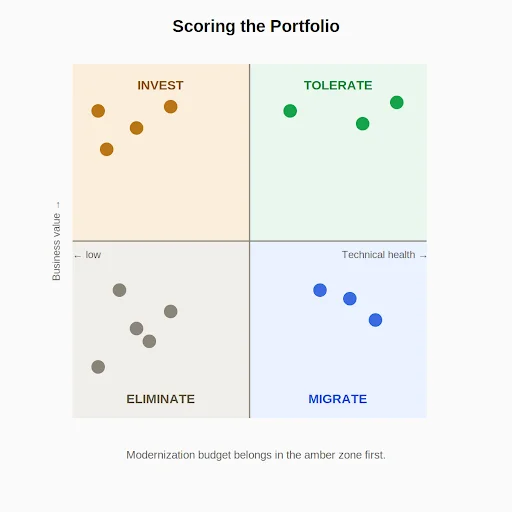
Mid-market organizations commonly run somewhere around 180 applications, and large enterprises routinely exceed 500. Most of that portfolio was never built or bought as a coordinated system, which is why Legacy Application Modernization Services work typically starts by mapping the portfolio before touching any single system.
It accumulated through acquisitions, departmental purchases, and one-off projects, which is why treating each application in isolation misses the real decision a business needs to make: not “how do we fix this system,” but “which systems does fixing anything even make sense for right now.”
The classic framework for this is TIME: Tolerate, Invest, Migrate, or Eliminate. Stripped of the jargon, it comes down to two questions plotted against each other.
How much is this application worth to the business, and how healthy is it technically right now?
Most portfolios have far more applications in the first and fourth categories than anyone expects, which is often the more useful finding than the modernization roadmap itself.
The scoring doesn’t need to be complicated to be useful. A rough 1-to-5 rating on each axis, agreed on by IT and the business owners who rely on each system, sorts a portfolio well enough to act on. That same technical-health question is the subject of code audit services, which examine a codebase for the security gaps and technical debt a simple age check would miss.
Cost at the portfolio level splits into two distinct line items that rarely get budgeted separately, and treating them as one number is where most estimates go wrong.
| Program Component | Cost (USD) | Cost (India, ₹) |
| Portfolio assessment (one-time, 20-50 applications) | 30,000-150,000 | ₹25 lakh-₹1.2 crore |
| Per-system modernization (ongoing, scales with sequence) | 30,000-2,300,000+ per system, depending on strategy | ₹2 lakh-₹1 crore+ per system |
The assessment is the step most organizations skip, even though it’s what makes every dollar spent land on the right system afterward instead of the loudest one. A full portfolio assessment for a mid-sized organization typically runs 8 to 16 weeks and produces that scoring. Per-system cost also depends heavily on who does the work: software development rates in India vary by role and seniority far more than most quotes admit.
Sequencing is where most application modernization strategies get decided, and it rarely comes down to picking the technically worst system first.
A system with real dependency load often needs its structure rebuilt while its business logic stays untouched, the core of what software re-engineering involves, since that combination keeps the systems around it from breaking.
Technology choice rarely decides the outcome as much as this ordering does. Programs that hold up share one trait: the sequence comes from the score, not from whichever system happened to get the most attention that quarter.
Phased almost always beats simultaneous, and the reasoning is more practical than strategic. A team can meaningfully manage a handful of modernization efforts at once; spreading the same budget across everything at once means every system gets under-resourced.
A phased approach also builds in a genuine advantage: the portfolio itself keeps changing while the program runs. A system scored as “tolerate” in year one can become the year-three priority once a compliance deadline or a departing engineer changes its risk profile. A program built around a single fixed roadmap can’t adapt to that; a phased one revisits the scoring at each phase and adjusts.
There’s a discipline benefit too. A team that ships one modernized system every quarter builds a track record it can point to when asking for next year’s budget. A team three years into an all-at-once rewrite with nothing shipped yet is defending a promise, not a result.
How a partner runs the software development life cycle across each phase is one of the clearest signals of whether a phased program will stay phased.
A single modernization project needs a project lead. A portfolio-wide program needs something closer to standing governance, since the scoring, sequencing, and budget decisions don’t end when the first system ships.
That typically means a small cross-functional group, IT, security, and the business owners of the highest-value systems, that revisits the portfolio score on a set cadence rather than only when something breaks. That structure is what keeps funding decisions tied to the score itself, rather than to whichever team raised the issue most recently, the same continuous-monitoring discipline behind NIST’s Risk Management Framework, which explicitly applies its process to systems of any age or size.
The cadence matters more than the formality. A quarterly thirty-minute review that happens on schedule works better than an annual steering committee that rarely meets as planned.
There’s no single application modernization roadmap that fits every portfolio, because the mix of systems, their condition, and the business risk they carry is different everywhere. The programs that hold up are the ones that score the portfolio honestly, sequence by actual risk and dependency rather than visibility, and keep revisiting that sequence as conditions change.
Zethic works with engineering and business leaders to run that scoring and sequencing before committing a modernization budget to anything, mapping which systems carry the most risk, which open up the most downstream work, and which are safe to leave alone for now, then builds the governance to keep that plan current as the portfolio evolves.
Ram brings deep expertise in product strategy and system architecture across fintech, SaaS, and AI platforms. He specializes in pre-execution planning to help teams build scalable technology foundations and avoid costly rebuilds.
