


Start Your Project Today
Tell us about your project — we’ll get back within 24 hours

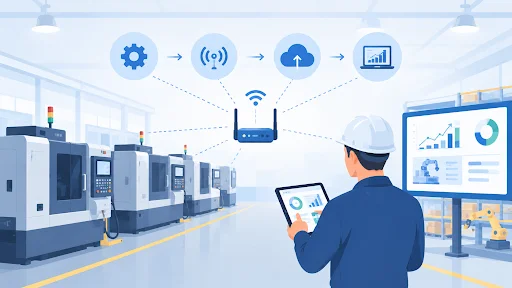
Most plants run machines that were bought long before anyone planned to connect them. A first project that ignores this tends to produce a dashboard nobody trusts, or a pilot on one line that never spreads. Digital transformation in manufacturing goes further when a plant starts with the machines it already has and picks the first target by what it can already measure.
Digital transformation in manufacturing is the move from paper logs, memory and separate spreadsheets to shared digital records of how a plant runs. It covers the data a plant already produces each shift, the software that collects it and the people who act on it.
Each record is useful on its own. Together they let a manager see why a line missed its target, not only that it did. Digital transformation services start by mapping which of these records a plant already produces.
Most machines on an older shop floor were built to run alone, not to share data. Their controllers may speak different protocols, and some have no network port at all. Operators fill the gap with clipboards, which keeps the plant running but hides the figures that planning needs.
Replacing a working machine rarely makes sense when the goal is data. A plant can read what a machine already produces, add a small sensor, or record the figures by hand on a tablet. The right route depends on the age of the controller, and one plant often uses all three.
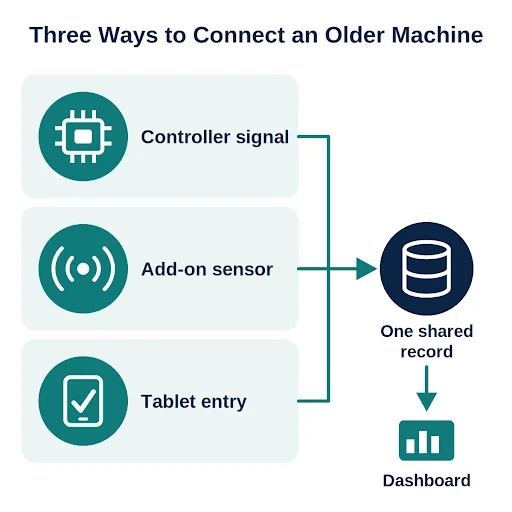
Keep the plant network separate from the office network during this step. A gateway that sends data out without accepting commands back stops a connected machine from being controlled from outside.
A manufacturing digital transformation strategy works best when it starts with one line chosen on evidence. Score each candidate line against five questions, then begin where most answers are strong.
| Criterion | Question to Ask | Strong Sign |
| Cost of a stoppage | What does an hour of downtime cost this line? | Stoppages hold up orders or waste material |
| Data already available | Can the machines share signals today? | Controllers or sensors are already in place |
| Repeatability | Do other lines use the same machine type? | The same setup can be copied across lines |
| Named owner | Who is accountable for the result? | One engineer or manager owns the line |
| Safe test window | Can the line stop briefly for installation? | A planned stop already exists in the schedule |
Lines that score well on cost and ownership give the fastest proof. A line with low data readiness can still be the right choice if its stoppage cost is high, since a sensor or tablet can close that gap. A digital transformation framework shows where each scored line fits in the wider plan.
The first examples to deliver benefits are the ones that make an existing problem visible. They need few new machines and produce a number that managers already care about.
The benefits of digital transformation in manufacturing build on each other. Downtime records feed maintenance planning, and quality records feed process and supplier reviews. Data engineering services keep those records consistent as more lines join.
Cost and timing depend on the size and age of the plant as much as on the software chosen. A single line with modern controllers can start sooner than a plant with many machine types.
Sensors and gateways form their own cost line, apart from software, so quote them separately when comparing proposals. Plants that start with one line can show a working result before committing to a second. A digital transformation process that runs one line at a time keeps the timeline easy to plan.
Micro, small and medium enterprise (MSME) plants can start with one line and one result, the same way larger plants do. In India, SAMARTH Udyog Bharat 4.0, a program of the Ministry of Heavy Industries, runs awareness campaigns, training and demonstration centers for manufacturers. It also offers consultancy that helps small and medium manufacturers plan Industry 4.0 projects on a chargeable basis.
Digital transformation in manufacturing holds up better when a plant picks one line with a clear stoppage cost, connects what its machines already produce, and shows a number the shop floor trusts before adding a second line. That answers the problem at the start: the first project is chosen by what a plant can measure today, not by the longest technology list.
Zethic begins with a short audit of one line, covering its machines, controllers, data sources and owner. It then builds the data pipelines and device firmware that turn those signals into reports the operations team uses, and it keeps the first scope small enough to show a result before the next line starts.
Ram brings deep expertise in product strategy and system architecture across fintech, SaaS, and AI platforms. He specializes in pre-execution planning to help teams build scalable technology foundations and avoid costly rebuilds.
