


Start Your Project Today
Tell us about your project — we’ll get back within 24 hours

Every article on how to choose an AI development company recommends the same checklist: check the portfolio, ask about expertise, look at client testimonials. Following that checklist rarely prevents the outcome it claims to protect against, since most vendors that fail in production pass every item on it easily. The real question a business needs answered is not whether a company can build an impressive demo, but whether it can get that demo into production and keep it working once real users and real data show up.
Portfolio reviews, case studies, and client testimonials all describe what a company has already shipped. None of them test whether a specific vendor can handle a specific project’s actual data, integrations, and edge cases.
This gap matters because AI systems behave very differently in a controlled demo than in live use. A demo runs on clean, curated inputs in a quiet environment. Production runs on messy real data, unpredictable user behavior, and systems the vendor has never touched before.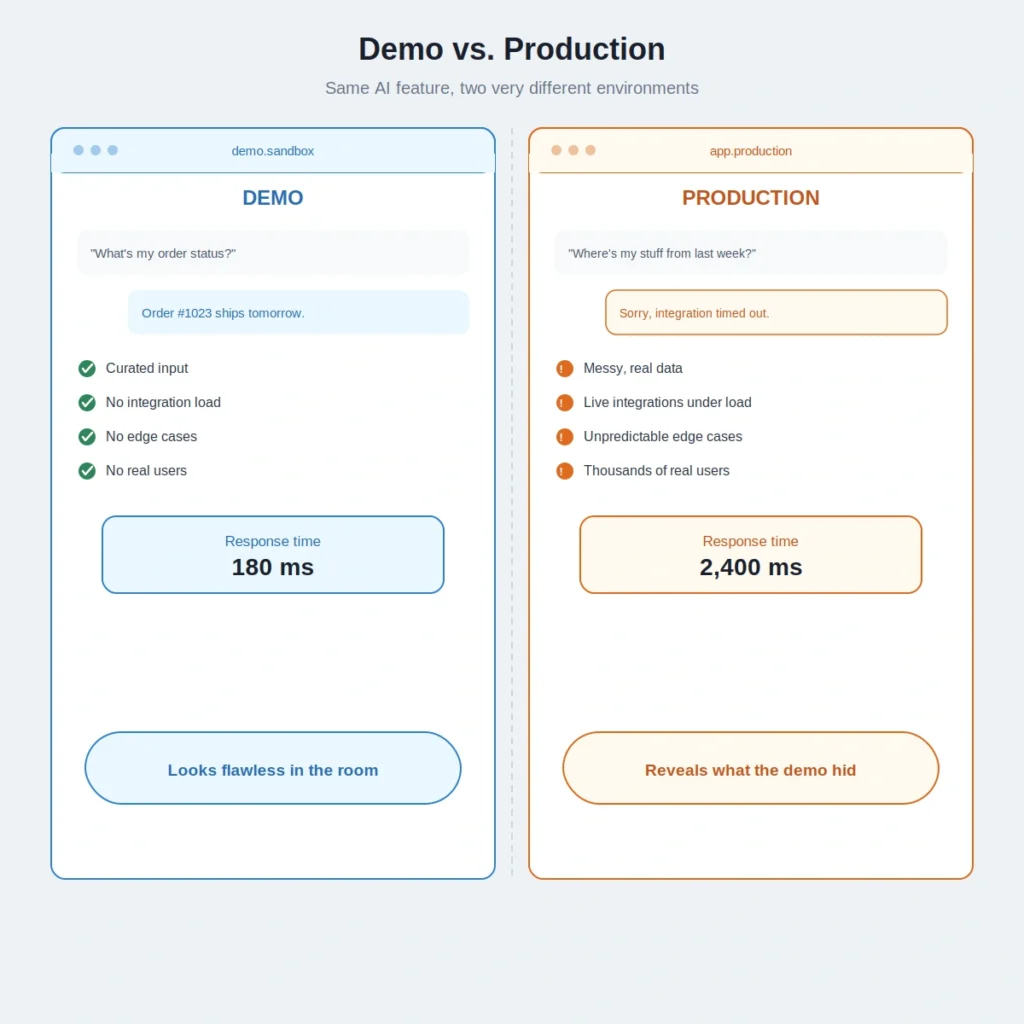
A company can be genuinely excellent at building demos and genuinely weak at the discipline required to get something working reliably in production, and the standard evaluation checklist rarely tells the two apart. This is exactly the gap India’s AI Governance Guidelines on accountability point to when they call for AI developers to remain visible and accountable based on the function they actually perform, not just the claims they make.
This is not a claim that portfolios and testimonials are worthless. It is that they answer a narrower question than most buyers assume they do: they show a company can build something that works once, under conditions the company controlled. They do not show whether the same company can build something that keeps working once a business’s own data, integrations, and users are involved.
A specific pattern shows up often enough to name directly: a company connects to an existing model’s API, adds a simple interface, and presents the result as a custom AI solution.
This is not inherently a problem. An API-based build is a legitimate, often appropriate choice for many use cases. The issue is when a business pays custom-development rates for what is actually a lightweight integration, without understanding which one it is getting.
A direct question resolves this quickly: what percentage of this company’s AI projects involve training or fine-tuning a model, versus connecting to an existing one? A company that answers this specifically, with real numbers, understands its own work. A company that answers only with general enthusiasm about “modern AI” is worth a closer look before signing anything.
Neither answer is automatically wrong. A well-scoped API integration can be the right call for a straightforward use case, and a business that needs exactly that should not pay for unnecessary model training, a distinction that follows the same logic as any build vs buy software decision. The problem only appears when the pricing and the description of the work do not match what is actually being delivered.
A handful of specific questions do more work than an entire generic checklist, because they ask a vendor to demonstrate rather than describe.
| Question to Ask | What a Strong Answer Looks Like |
| Can you run this on our actual data, not a curated sample? | A specific yes, with a plan for how that test would work |
| Which specific systems have you integrated with, and which version? | Named systems and versions, not “we integrate with most platforms” |
| What went wrong in your last production deployment? | A specific incident and what changed afterward |
| What does your post-launch monitoring actually track? | Concrete metrics, not a general assurance of support |
A vendor that answers all four with specificity is demonstrating exactly the kind of transparency that predicts a project reaching production. A vendor that answers only in general terms is optimized for the sales conversation, not the build.
These four questions work precisely because they cannot be answered convincingly with prepared marketing language. A team that has genuinely done the work has specific answers ready, the same discipline that matters when evaluating any mobile app development outsourcing partner, not just an AI one. A team that has not usually reveals this within the first follow-up question.
How to choose an AI development company also depends on what happens after launch. AI systems are not static once deployed, and model behavior can shift as the data feeding it changes, which means post-launch support is a genuine ongoing requirement, not an optional add-on.
A company that treats post-launch support as a checkbox rather than an ongoing engineering practice is describing a one-time build, not a system a business can rely on for years.
Asking a prospective partner to describe their actual retraining cadence reveals a lot about how seriously they treat the system after the initial handoff. Whether that means updates once a quarter, whenever a model provider changes something, or only when a problem surfaces, a vague answer usually means the same team has not maintained many systems long enough to have a real one, undermining the exact advantages of outsourcing app development a business is paying for in the first place.
Claims made in a sales conversation are easy to make and hard to disprove without independent verification. A few concrete steps close that gap before a contract is signed.
Requesting a working code sample, not a slide deck, from a comparable past project reveals more about actual technical skill than any case study. Speaking directly with a reference client about what happened twelve months after launch, not just at the pilot stage, surfaces whether the relationship held up under real conditions.
A business that skips this verification step is relying entirely on what the vendor chooses to present, which is rarely the full picture. The businesses that avoid the worst outcomes are consistently the ones that insisted on seeing evidence rather than accepting assurance.
None of this verification work takes long. A single reference call and one working code sample can be arranged within days, the same due diligence that applies when hiring an offshore software development team in India, and the answers they surface are worth far more than another round of polished slides.
How to choose an AI development company ultimately comes down to verification, not just checklist items. The checklist advice is not wrong; expertise, communication, and portfolio all matter, but none of those factors reliably predict whether a specific vendor can carry a specific project from a working demo to a system that holds up in production.
Zethic works from this same principle when businesses evaluate the team directly: real production examples, specific answers about integration depth, and a track record a business can verify rather than simply take on faith. Zethic treats this evaluation process as something worth earning, not a formality to get past on the way to a signature.
Ram brings deep expertise in product strategy and system architecture across fintech, SaaS, and AI platforms. He specializes in pre-execution planning to help teams build scalable technology foundations and avoid costly rebuilds.
