A bank funds a mobile app, a digital onboarding flow, and a support chatbot, and then the board asks a plain question: what changed in cost or revenue? That question is harder to answer than it sounds, because digital projects tend to share costs, teams, and data with the systems around them. Digital transformation in banking is easier to fund than to prove, and the proof depends on decisions made before a project launches.
What Does Digital Transformation in Banking Mean?
Digital transformation in banking means changing how a bank operates and earns money through digital technology, rather than adding a digital channel to an unchanged process. A mobile app that shows balances is digitization. Rebuilding account opening so that identity checks, credit decisions, and account creation run on shared data is a change in how the bank works.
The term carries different meanings from bank to bank, so each bank defines it for itself, and a
digital transformation framework is one way to write that definition down. A working test helps: a project counts as banking digital transformation when it changes a cost, a speed, or a revenue line that the bank can measure.
What Makes the Results of Digital Transformation in Banking Hard to Attribute?
Many banks can report digital channel use and transaction volumes, yet tying that activity to cost and revenue through key performance indicators (KPIs) is much harder. A project may lift sign-ups while its cost sits inside a shared budget, or cut handling time while the saving never reaches a ledger.
Of all the digital transformation challenges in banking, attribution is among the few that come down to planning rather than technology. The usual causes are structural:
- Shared costs: Teams, platforms, and vendors serve several projects at once, so one project’s spend is rarely recorded on its own
- Baselines: Projects often launch before anyone records the previous cost per account, loan, or support query
- Split data: Channel, core banking, and finance systems each hold part of the picture and seldom reconcile at project level
- Overlapping changes: Pricing, staffing, and marketing shifts in the same quarter blur the effect of a launch
None of these causes needs new technology to resolve. Mapping out a
digital transformation process in advance, with each project’s baseline and data sources fixed before launch, closes most of these gaps before they ever form.
Which Metrics Show That a Digital Project Is Working?
A useful metric for digital transformation in banking pairs a result with the data needed to attribute it. The table below matches four common projects in retail banking to the result each should move and the records required to prove it.
| Digital Project |
Result to Measure |
Data Needed to Attribute It |
| Digital onboarding |
Cost per onboarded customer and onboarding completion rate |
Pre-launch cost per account, drop-off data by step, staff time records |
| Digital loan origination |
Time from application to decision and cost per loan |
Application timestamps, underwriting hours, loan volume by channel |
| Digital customer support |
Cost per resolved query and share of queries resolved without an agent |
Contact volumes, handling time, agent cost per hour |
| Product launch tooling |
Time from approved idea to live product |
Release dates, change requests, core banking system configuration lead time |
Indian regulation already treats measurement as part of technology governance. Under the Reserve Bank of India’s
technology risk directions for commercial banks, in force since July 2026, banks must develop metrics that include key performance indicators, use a scorecard or methodology to measure IT performance and IT maturity, and run a board-level IT strategy committee that meets at least quarterly. Each KPI also needs a written measurement method, a named owner, and a review rhythm that matches its audience, quarterly for executives and near real time for operations.
At bank level, the cost-to-income ratio (operating costs as a share of operating income) is a measure boards and investors already read, so bank digital transformation KPIs are more persuasive when they can be tied to it. One workable measure is a “digital dividend” that adds up revenue from digitally sold products and sets it against the maintenance and investment costs of each digital project. Because several projects can draw on the same source data, the reconciliation work behind these measures need not multiply with each new project.
In What Order Should a Bank Digitize Its Operations?
Order matters more for digital transformation in the banking industry than in most sectors because the ledger cannot stop. A bank cannot pause its core banking system, the platform that records accounts and balances, for a quarter to rebuild it, so each project has to produce results while existing systems keep running.
A practical order follows data dependency. Projects that sit mostly in front of the core, such as onboarding, document collection, and customer support, can launch through a defined interface and produce results that are easy to compare against a baseline. Projects that need transactions recorded in real time or new product structures often involve
legacy software modernization inside the core and follow later.
Sequencing does not mean postponing the harder work. Core changes can be planned in parallel, with each project in front of the core capturing the data a later change will need, such as transaction timestamps and product usage.
A written roadmap helps here: it shows which projects other projects depend on and which milestones must be reached before a dependent project can proceed. Outside providers belong on that roadmap from the first project, because projects that open up a bank’s IT systems increasingly depend on them.
What Does a Measurable Digital Project Look Like in Practice?
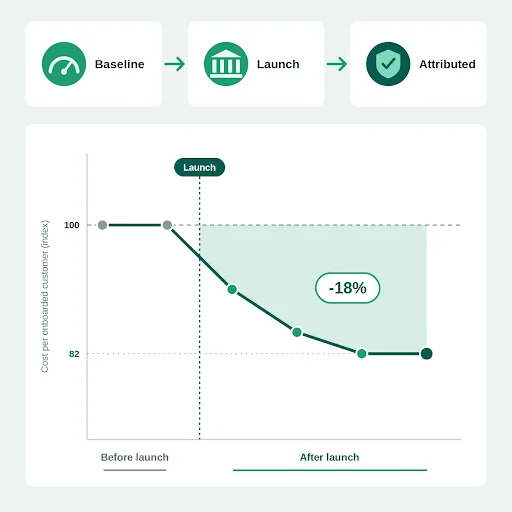
Consider a composite mid-size retail bank, not any single institution, replacing paper-based account opening with a digital flow. Before launch, the team records two quarters of cost per onboarded customer, set to an index of 100, along with drop-off rates at each step. Those two quarters become the baseline.
After launch, the same measures run for four quarters. Cost per onboarded customer settles near 82, an 18 percent reduction, and completion rises as the largest drop-off step disappears. Because the baseline and data sources were fixed in advance, the bank can also check whether pricing or staffing changes overlapped the period and adjust the comparison.
The same method carries over to every later project, and a bank that scopes its work through
digital transformation services can write the baseline and data sources into each scope. Each later project reuses the data sources and the baseline approach, so the bank’s evidence builds across projects instead of restarting each time. This is how digital transformation in retail banking becomes something a board can verify.
How Can a Bank Build a Digital Program It Can Measure?
Digital transformation in banking becomes provable when each project starts with a recorded baseline, named data sources, and a clear path into the cost-to-income ratio. That answers the board’s opening question before anyone asks it: what changed.
Zethic designs digital banking software around the data each project will be judged on, connecting the systems that hold baseline and result figures so the effect of a launch can be attributed once it goes live. Banks that begin with one project and a recorded baseline give every later project a tested method to reuse.