Three vendors can quote three wildly different numbers for what sounds like the same “predict customer churn” project, and none of them are necessarily wrong. Machine learning development cost depends less on the algorithm than on how clean the data is, how the model gets maintained after launch, and which of several distinct project types a business needs.
What Counts as Machine Learning Development?
Machine learning development covers models that learn patterns from a business’s own structured or semi-structured data to predict, classify, or recommend something, tasks like forecasting demand, flagging fraudulent transactions, or scoring credit risk. This is a different category of work from generative AI development, which builds on large language models to generate text, images, or conversation.
The distinction matters for budgeting. A classical machine learning model is typically smaller, trains on a business’s own historical data, and costs far less to run in production than a large language model does. Generative AI development cost in India and machine learning development cost are frequently quoted side by side, but they solve different problems and rarely compete for the same budget line.
What Does Machine Learning Development Cost by Project Type?
Machine learning development cost varies more by project type than almost anything else in the budget. A simple model that predicts a number or category from clean, structured data costs a fraction of what a computer vision system trained on millions of images requires.
| Project Type | What It Involves | Cost (USD) | Cost (India, ₹) |
| Classification/regression | Predicting a category or number from structured data (credit scoring, lead scoring) | $15,000-$50,000 | ₹2 lakh-₹8 lakh |
| Forecasting | Time-series prediction (demand, sales, churn) | $40,000-$150,000 | ₹8 lakh-₹30 lakh |
| Recommendation engines | Tailored suggestions from behavioral data | $40,000-$150,000 | ₹8 lakh-₹30 lakh |
| Computer vision | Image or video-based detection and classification | $150,000-$1,000,000+ | ₹30 lakh-₹5 crore+ |
These bands assume reasonably clean, available data. A business starting from scratch on data collection should expect the lower project types to drift toward the cost of the tier above them.
The U.S. Bureau of Labor Statistics reports a median annual wage of $120,230 for data scientists, and even a small team working for a few months on the higher tiers accounts for a real share of that total budget before any infrastructure or tooling cost is added.
Why Do Quotes for the Same Project Vary So Much?
The same “build us a churn model” request can return quotes 5 to 10 times apart, and the gap rarely comes down to one vendor overcharging. Two factors explain most of the spread: where the development team is located, and how much model complexity the vendor is quietly building in.
Team location alone can account for a large share of the difference. Hourly rates for machine learning talent run roughly $25-$50 in India, $45-$85 in Eastern Europe, and $99-$180 or more in the United States, so the same scope of work can land at different totals depending purely on who is doing it. This is the same tradeoff at the center of the in-house vs outsourced AI development decision, since team location changes the total more than almost any technical choice.
Model complexity closes the rest of the gap: a vendor quoting low may be scoping a simpler baseline model, while a higher quote might include ensemble methods, hyperparameter tuning, or a more rigorous validation process the cheaper quote skipped entirely.
- Team location: The single largest swing factor, often explaining more of the price gap than the technical scope itself
- Model complexity: A baseline model and a tuned ensemble model can solve the same problem at meaningfully different price points
- Validation rigor: Cross-validation, hold-out testing, and bias auditing add real cost that a bare-bones quote may simply omit
How Much Does Poor Data Quality Add to the Cost?
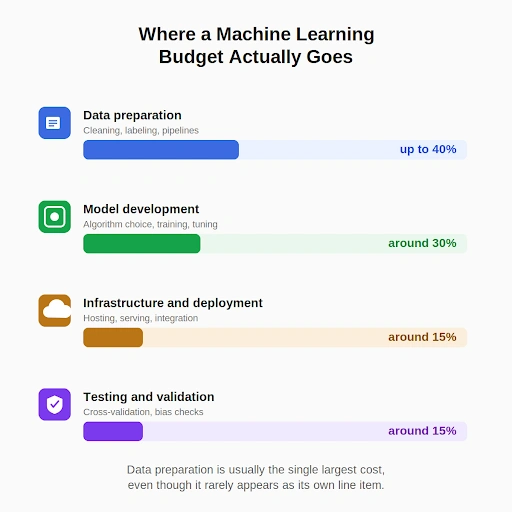
Data quality is the machine learning development cost driver that catches the most businesses off guard, since it rarely shows up as its own line item in an initial quote. Messy, incomplete, or siloed data can consume up to 40% of a project’s total budget on its own, all before a single model gets trained.
This cost shows up as data cleaning, labeling, deduplication, and building the pipelines needed to get raw business data into a usable shape. Getting from raw business records to a usable dataset is the kind of groundwork a custom software development company scopes before ever touching the model itself.
A business with years of consistent, well-labeled records pays near the bottom of the cost bands above. A business whose data lives across five disconnected systems, with inconsistent formatting and missing labels, should expect to pay for that gap before the machine learning work even starts.
Should You Build a Custom Model or Use a Pre-Built One?
Not every use case needs a model trained from scratch on a business’s own data. Pre-built tools and APIs handle common, well-served problems at a fraction of the cost, often $10,000-$20,000 including setup, but come with recurring license fees and real limits on customization.
A custom model costs more upfront, commonly $60,000 or more for a working first version, but the business ends up owning the model, the data pipeline, and the roadmap outright. This mirrors the broader custom software vs off-the-shelf decision, where the cheaper upfront option isn’t always cheaper once the total cost of ownership is counted. Pre-built tools make sense when the use case is common and already well-served; custom development earns its cost when the model’s specific behavior is core to what makes the product valuable.
What Should You Budget for Ongoing Maintenance and Retraining?
A model’s accuracy on launch day is not where it stays. A peer-reviewed study published in Scientific Reports by Vela et al. (2022) tested 128 model-and-dataset combinations across finance, healthcare, transportation, and weather, and found that 91% of them showed measurable performance degradation over time, even when the underlying data showed no obvious sudden change.
That is the reason most production teams budget 15-25% of the initial build cost every year for retraining, monitoring, and data updates. Skipping this line item does not remove the cost; it just moves it further downstream into a model that quietly gets worse until someone notices the business impact.
Which Industries Get the Highest ROI from Machine Learning?
Not every business gets the same return from the same machine learning investment. The industries seeing the clearest payoff tend to share one trait: a high volume of repeatable decisions where even a small accuracy improvement compounds into real money.
- Financial services: Fraud detection and credit scoring models catch losses that scale directly with transaction volume, the same pattern behind how fintech apps detect fraud
- Healthcare: Diagnostic support and clinical data extraction models reduce costly manual review at scale
- Retail and e-commerce: Demand forecasting and recommendation engines directly move revenue and reduce excess inventory
- Manufacturing: Maintenance-forecasting models cut unplanned downtime, which is often the single largest cost in the operation
How Should Your Business Budget for Machine Learning Development?
Machine learning development cost is not one number; it is a set of decisions: which project type fits the business problem, how ready the underlying data is, and how much ongoing maintenance the business is prepared to commit to after launch.
Zethic works with founders and CTOs to size these decisions before a project starts, scoping which project type fits the actual business problem, assessing data readiness honestly before it becomes a hidden cost, and planning the maintenance budget a model will need to stay accurate; Zethic builds the resulting system around a realistic budget rather than a launch-day estimate.